Western Balkans Part VII : Bosnia and Herzegovina 🇧🇦

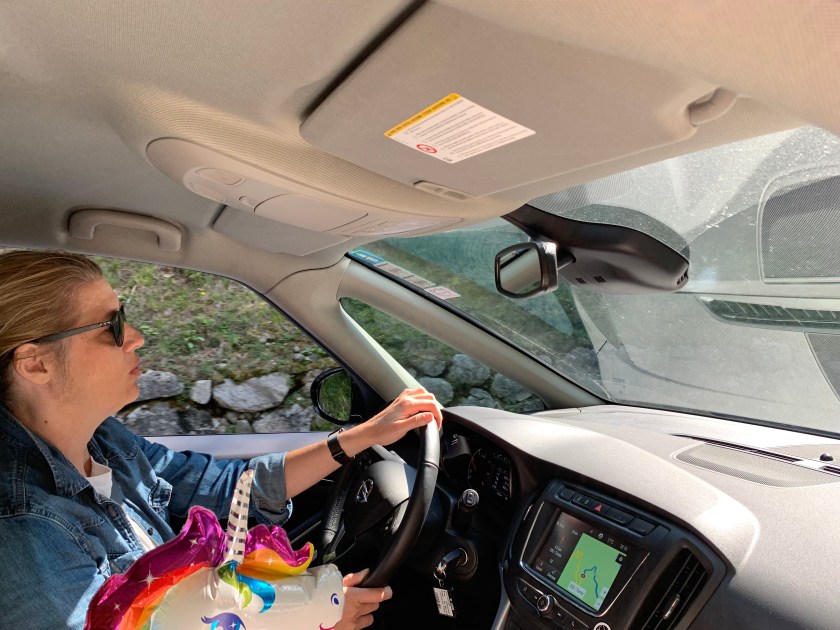
This morning we pick up a car and head north along the coast to a town called Neum which sits on the small part of coastline that is part of Bosnia. I can’t say I’m overly excited about the idea of driving a manual car, on the right (wrong!) side of the road, on these windy, twisty roads but I’ll give it a go. I’m doing the driving (not because I’m the best driver but I’m certainly not the greatest at reading maps!!) and Shane will do what he’s particularly good at – navigating. 😁

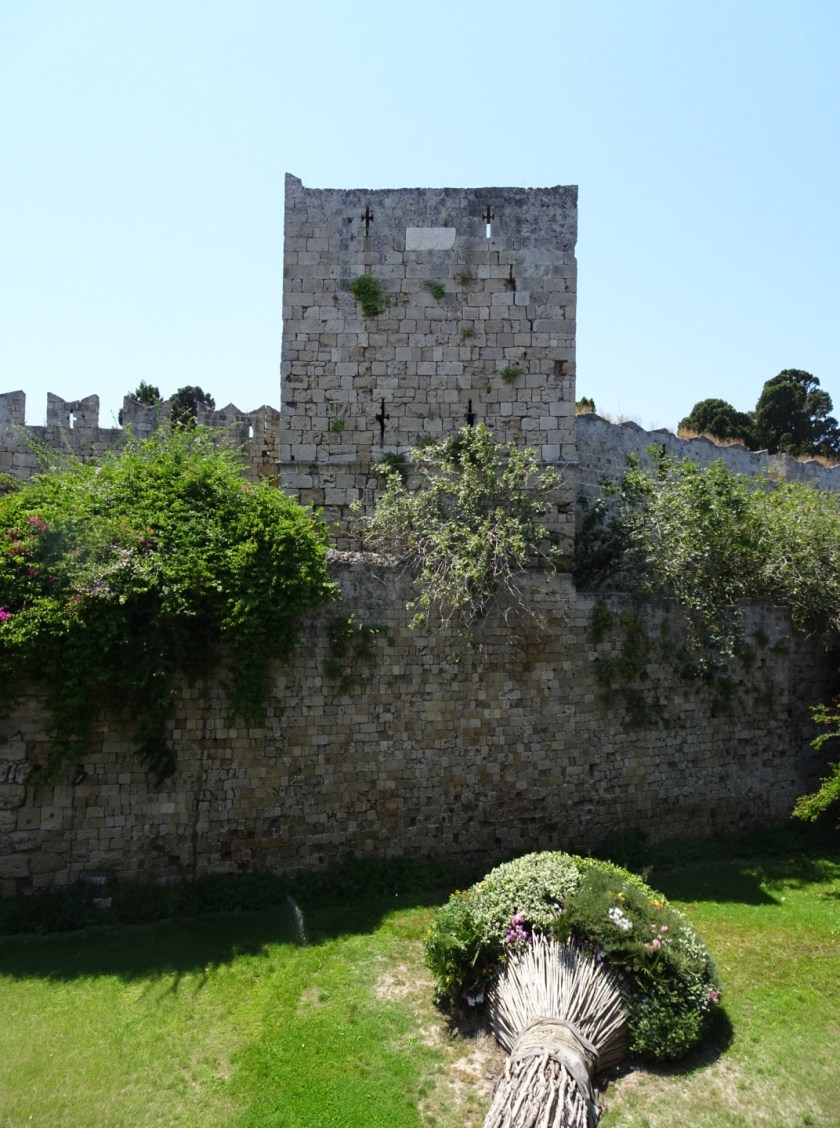
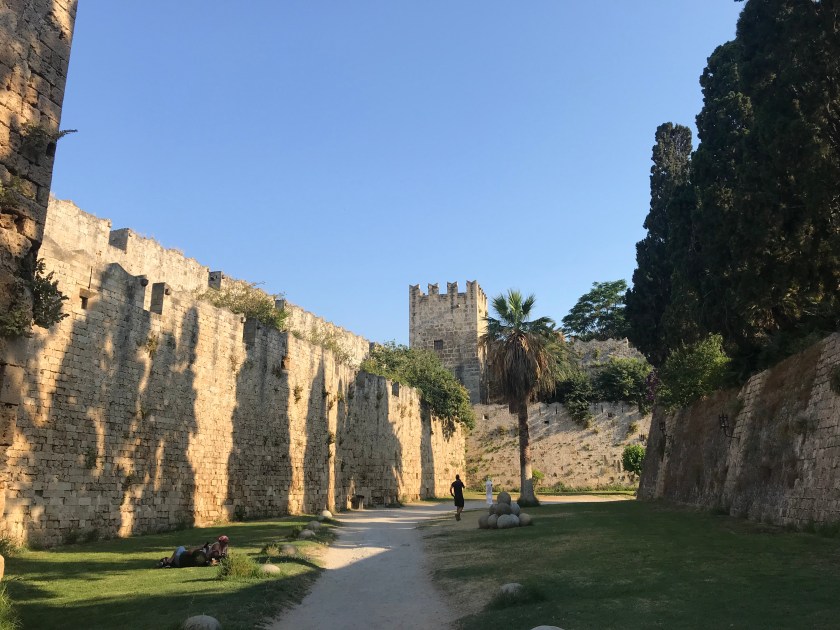
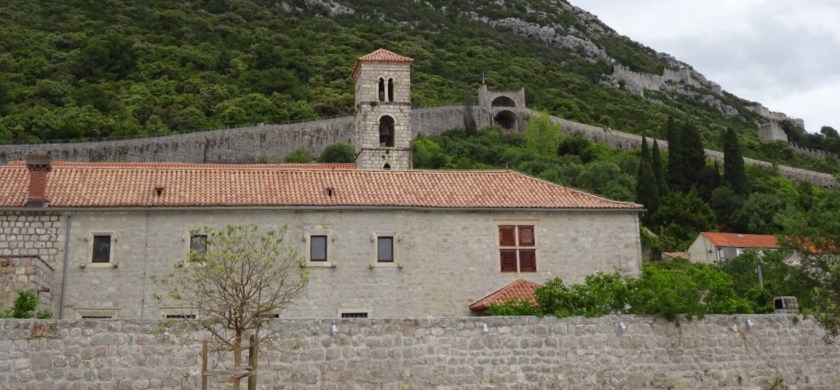
We manage to get out of Dubrovnik without any incident, thanks to the aforementioned navigation skills, and we head north up the Croatian coast. We stop in The Croatian town of Ston for a quick look at the walls which are very impressive:

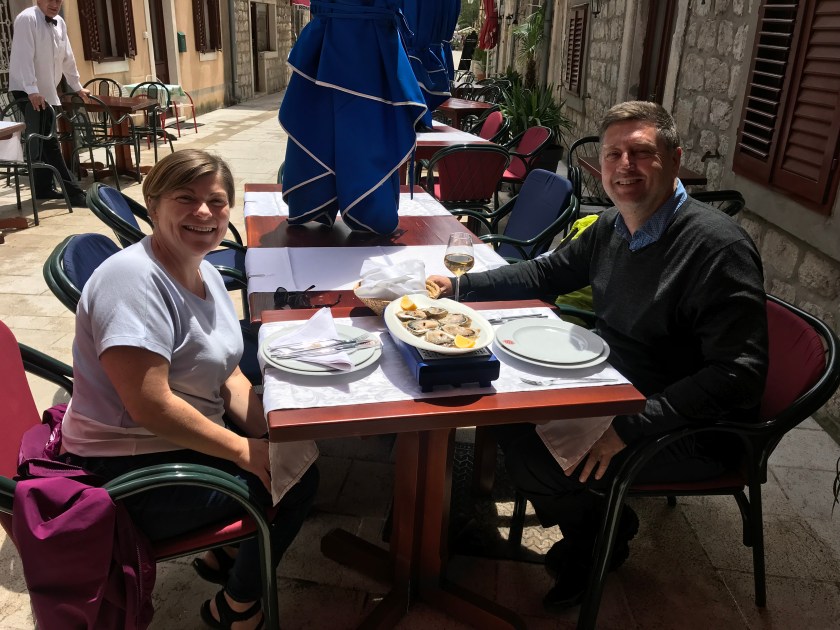
And of course we have some lunch. Ston oysters seem to be a thing as we’d seen them on menus elsewhere, so we sit down to a seafood lunch of oysters, mussels, squid and black risotto. It’s excellent…. We’re the only people in the restaurant so it’s very quiet but it’s a nice relaxing hour sitting in the sun.

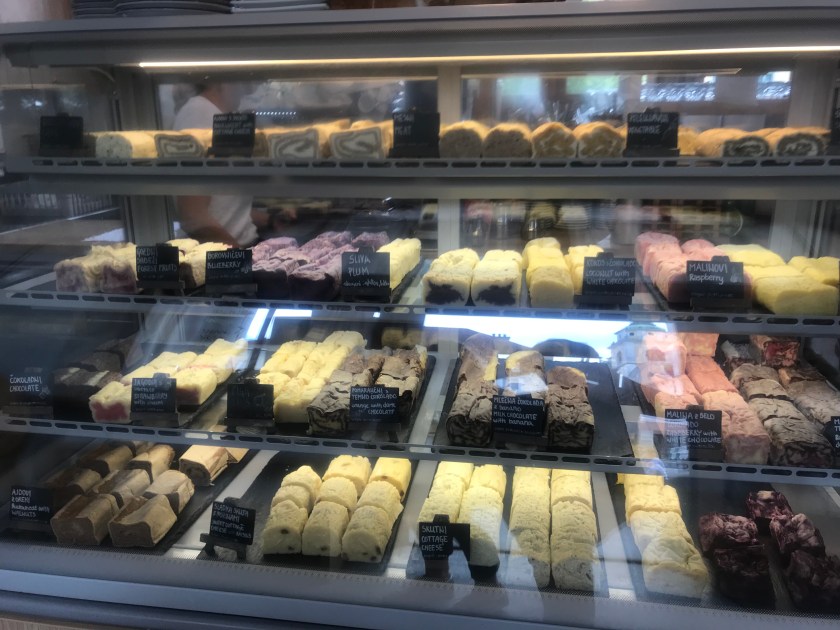
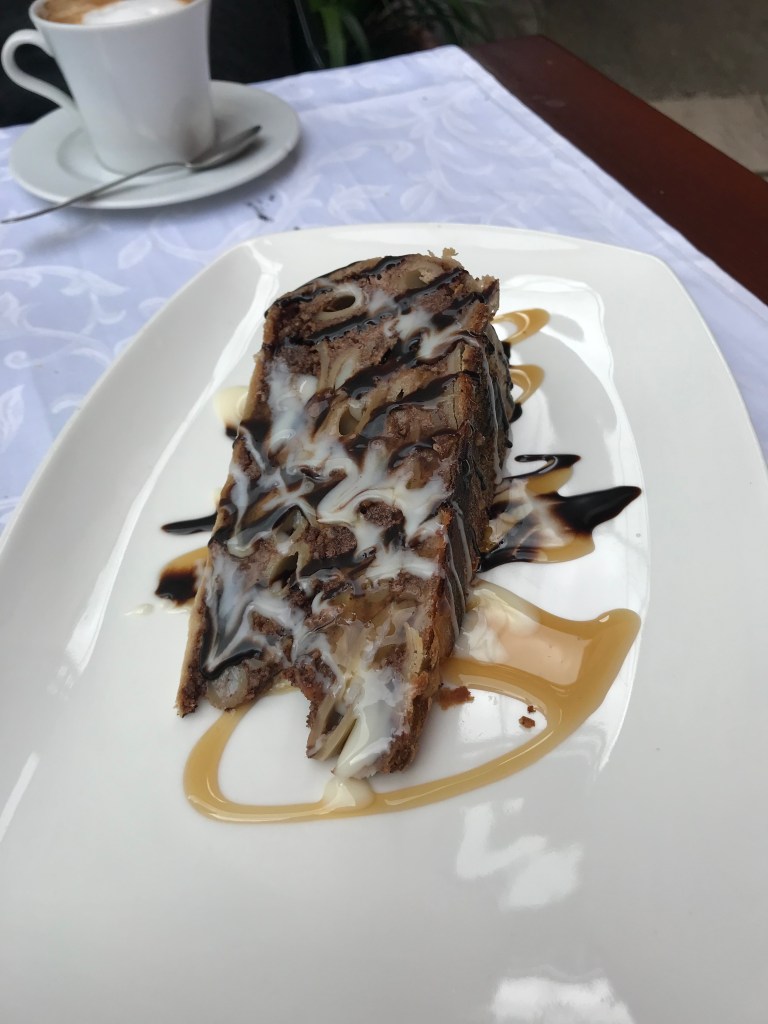
I spotted some cakes twirling in a glass fridge as I sat done and I’m intrigued by what they are…one in particular looks like a huge round of cheese and the inside looks like pasta… crazy! I ask the waiter what it is and he confirms it’s pasta cake. We have to try it… it’s very nice but filling after a big lunch. It’s got pasta with chocolate filling surrounded by pastry – not really like anything I’ve ever had before.

We continue along the coastal road and it’s not too long til we arrive at the border. We are ready with our passports and this time there is only one checkpoint. It’s like going through a toll booth and I’m not even sure if it’s a Bosnian checkpoint or a Croatian one. There’s no queue and it’s fast and easy to pass through – happy days! Within minutes we arrive at Neum.

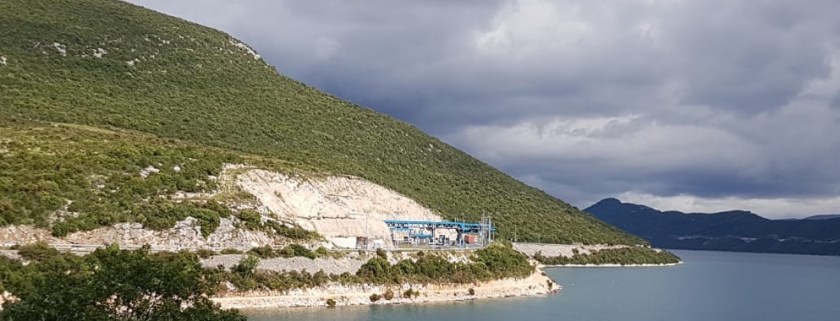
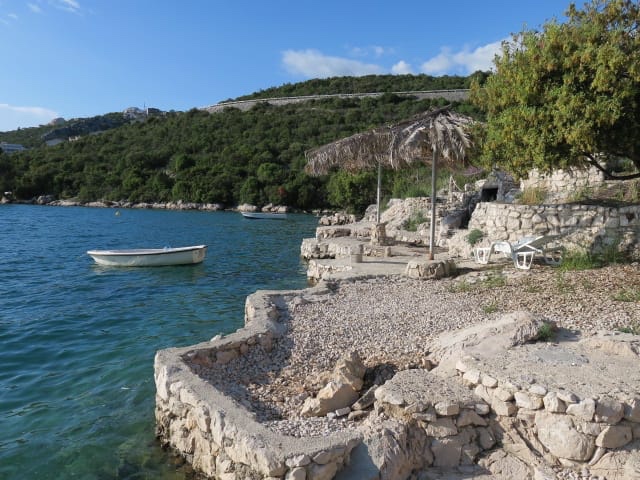
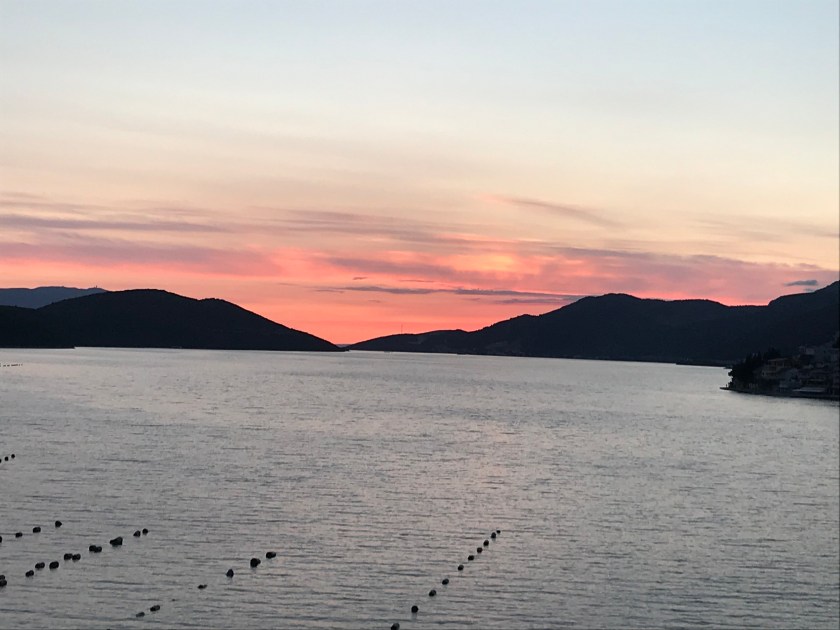
Neum is a coastal resort but right now it’s very much off season and not a lot is open. We are staying at an Airbnb which has a nice view and we’re hoping it’ll warm up enough to sit on the balcony! We do have a really nice view onto the water:

We check out the local shop which takes Euros, Bosnian and Croatian money and eat at a restaurant right beside the apartment so no more driving for me today and I can have a nice glass of local wine.

Next day we are taking a trip to Mostar with a quick detour to Medjugorje. For those of you who have never heard of Medjugorje, it’s a small town made famous in the 80’s by a group of teenagers who alleged they had apparitions of the Virgin Mary. Those of you who know me, know that I’ve always had a special interest in Virgin Mary apparitions – Fátima, Lourdes, Knock and this one happened and continues to happen (yep she’s still appearing every year) in my lifetime. I was fascinated by the story when I was growing up so I can’t miss the opportunity to visit as we’re practically passing by on our way to Mostar!

Google tells us it’s just over an hours journey to Mostar but we seem to take the “country roads” and about two hours later we arrive!! We could have taken a route through Croatia but we decide to stay in Bosnia and see the countryside… it’s green and beautiful all around as we climb up over valleys on winding bends with hairpin turns. I don’t think we get over 80km the whole time!

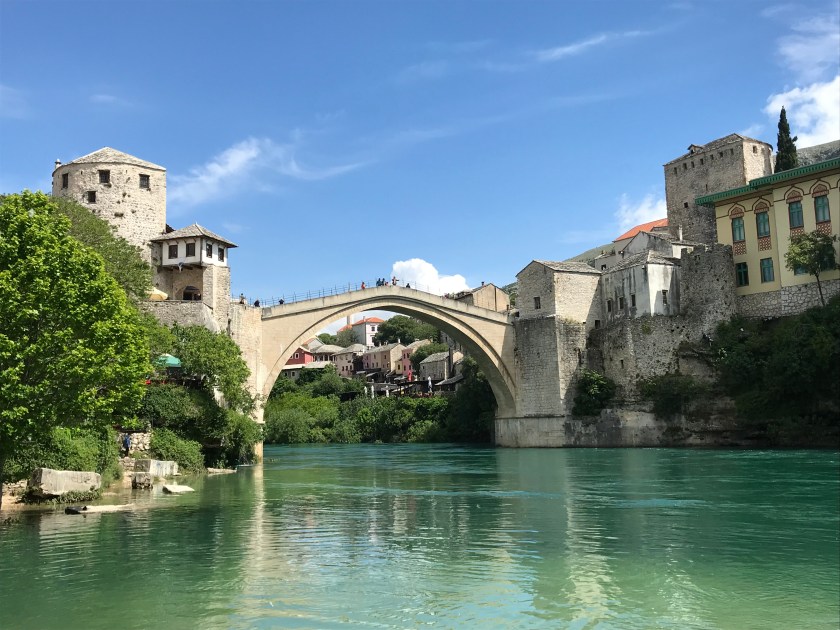
Mostar is a small town with a famous stone bridge from the 16th century but it was damaged badly during the Balkan wars and it collapsed in 1993. They rebuilt it to more or less exactly how it looked before and it is stunning.

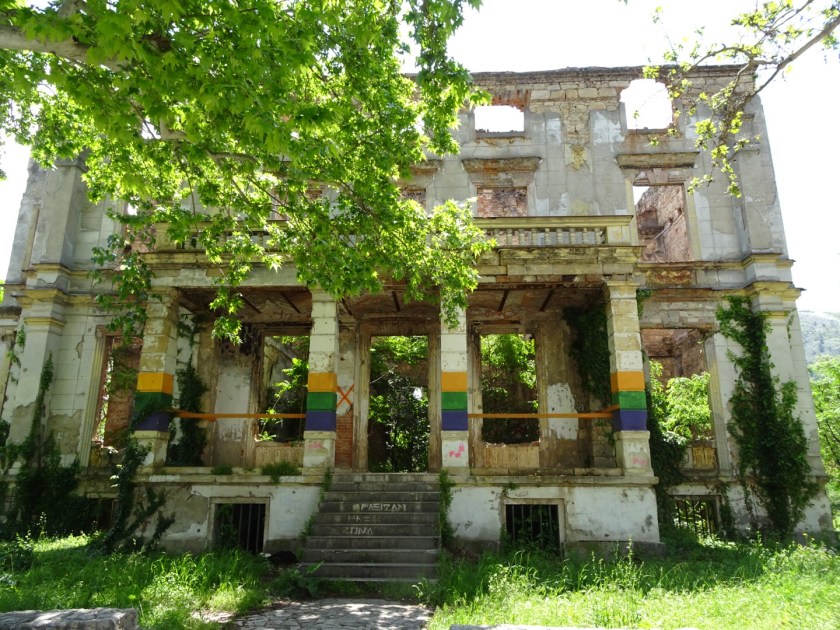
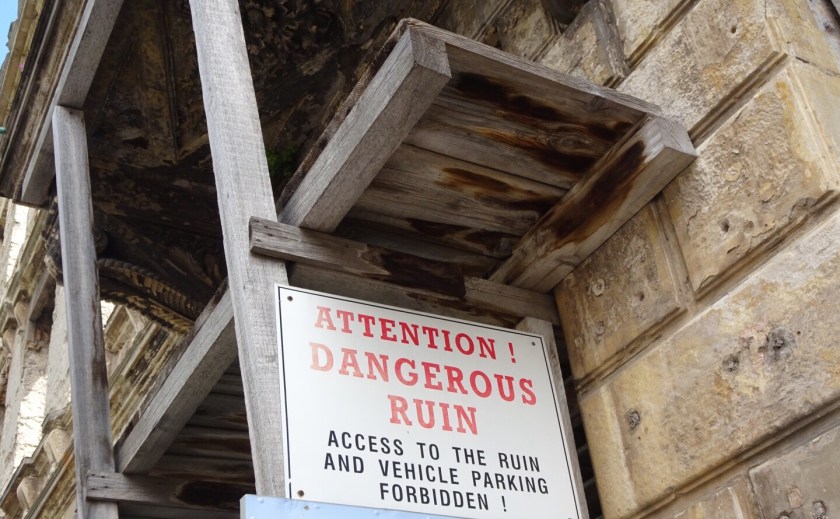
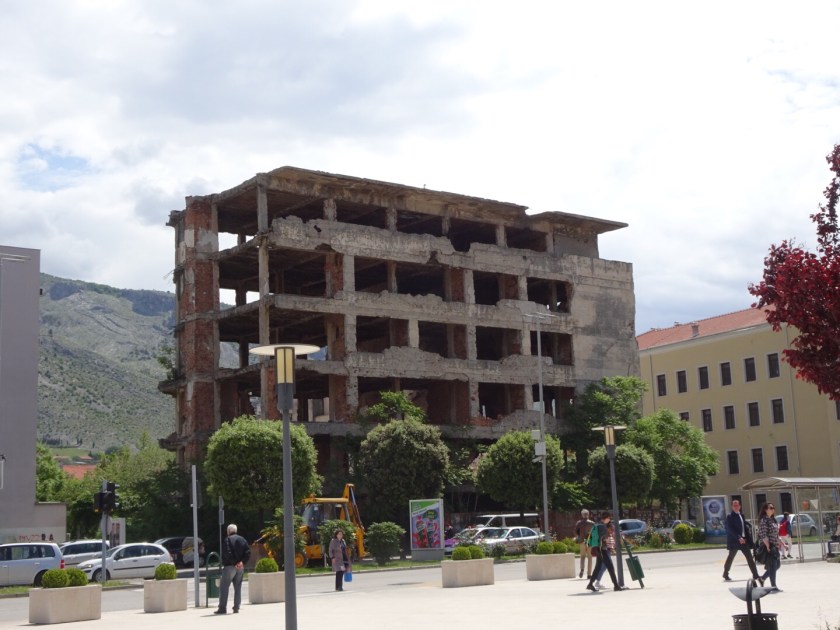
We walk around the town and see lots of ruins of buildings that were bombed in the war.

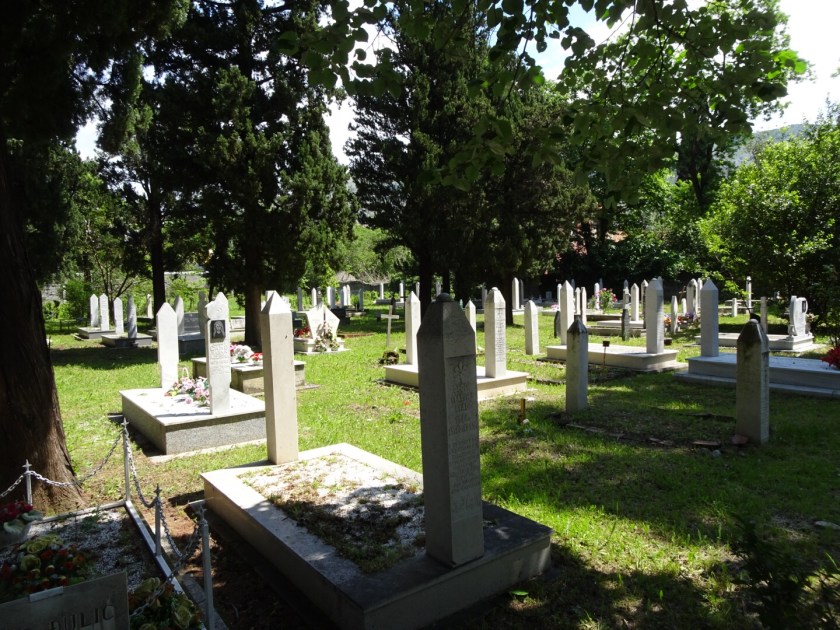
We pass a number of cemeteries, the first entirely full of people who died in 1992, the second full of gravestones with deaths in 1993…. such sad years for the country…

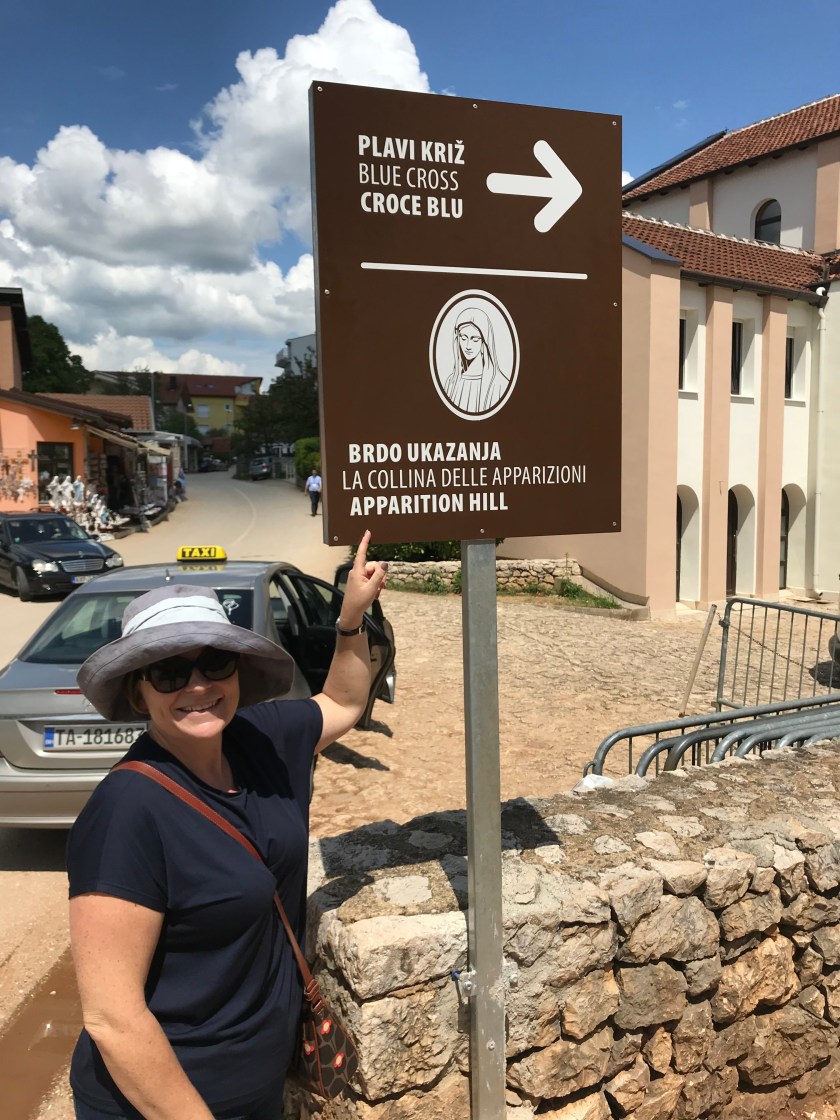
After a couple of hours rambling around we get back in the car and set off for Medjugorje. It’s only half an hour from Mostar and as we arrive into town we can immediately see the impact of the apparitions on tourism. It’s not overly busy but there are buses of pilgrims and the streets are lined with shops selling rosary beads, medals, statues of Our Lady… you can even get a bottle opener with Our Lady on it! Undeterred and actually quite excited (that’s just me!), we head for Apparition Hill.
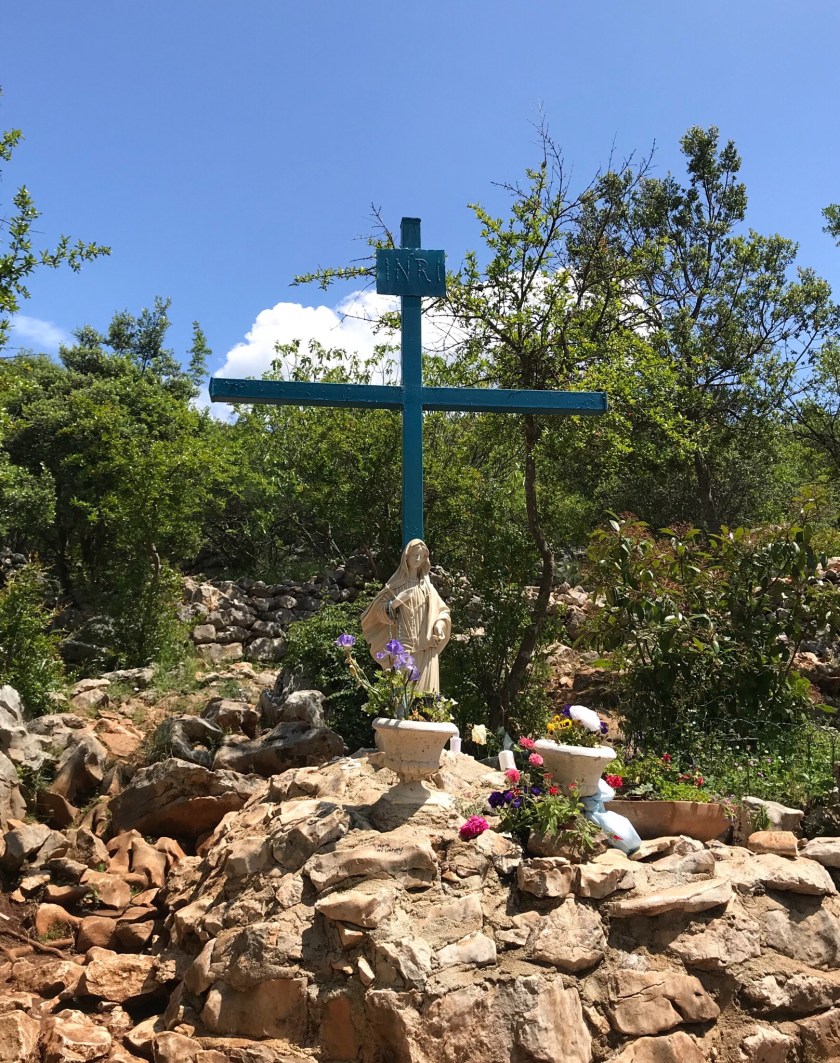
There are two spots with a statue of our lady and a blue cross so I assume she appeared in both places although it must be difficult to pinpoint the exact spot as she appeared so many times to the teenagers on this hill and in the small church.
Pilgrims are sitting around, many with rosary beads praying and periodically touching the statue and kneeling in prayer. I’m happy to see the place and say a little prayer but still not sure what to make of the whole thing. Pope Francis is apparently not convinced of its authenticity but The Vatican is still investigating and hasn’t given its final word.

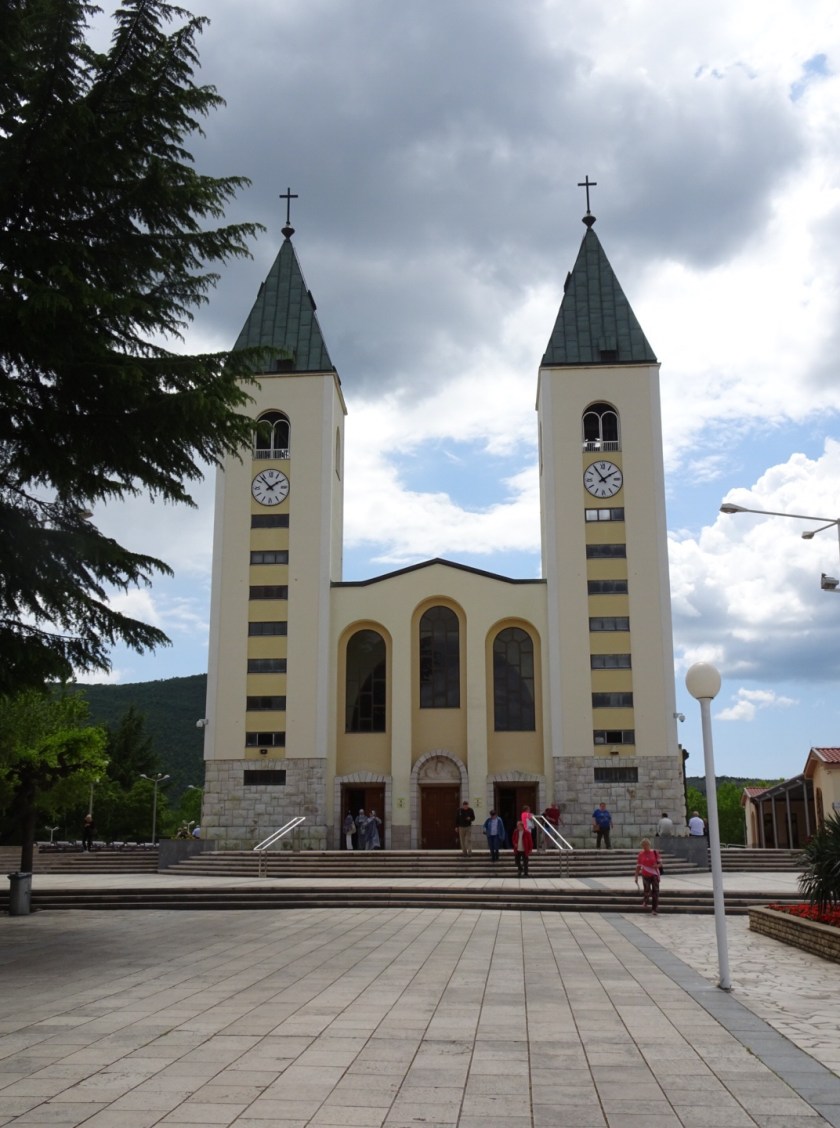
Back on the Main Street of the town we visit St. James church and that’s Medjugorje ✅

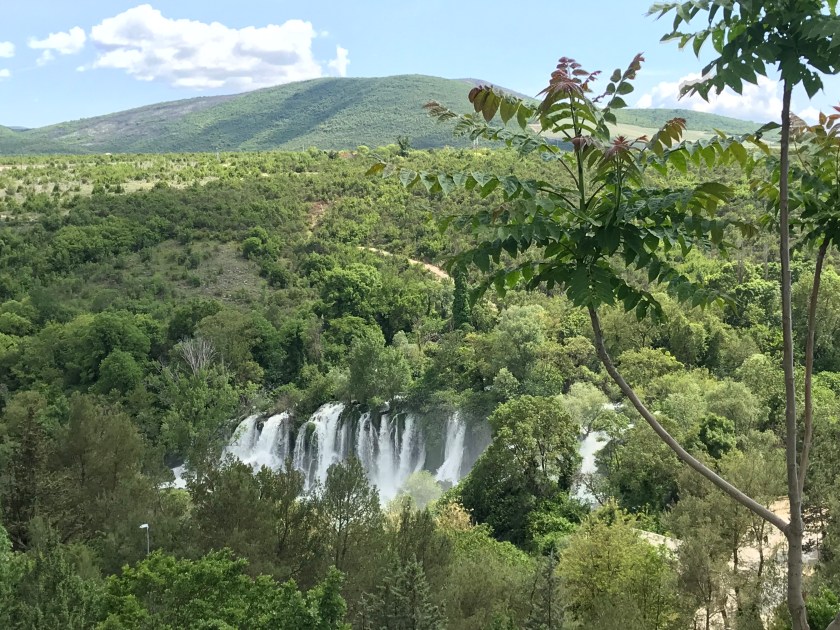
As we are leaving we see a sign for a tour to some waterfalls called Kravica. We find out they’re only about ten kilometers away so we decide to check it out before taking the road back, through Croatia this time, to Neum.

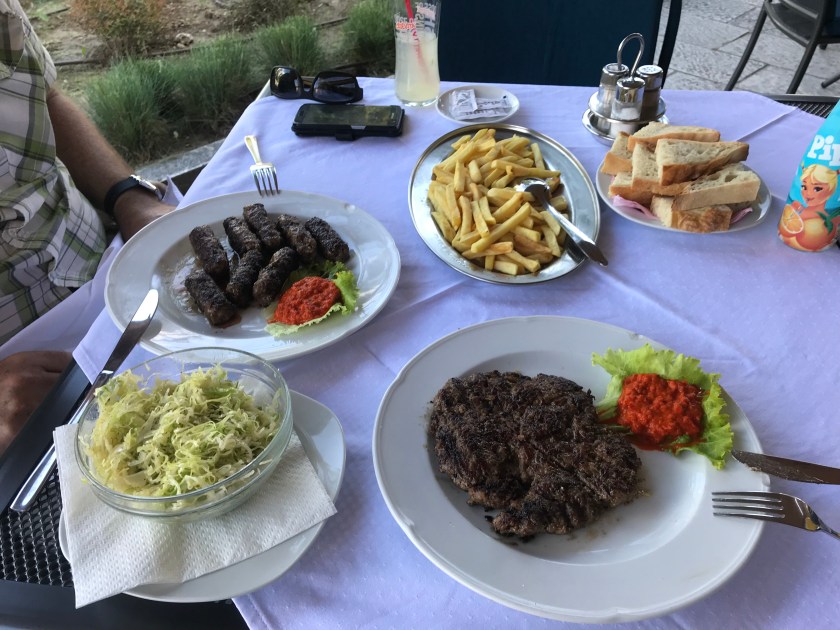
The roads are still windy but much better going through Croatia and after another easy border crossing we stop in a town called Metkovic for our final Balkans meal. In true Balkan style we stick to meat (I love my chevapi), salad and bread.
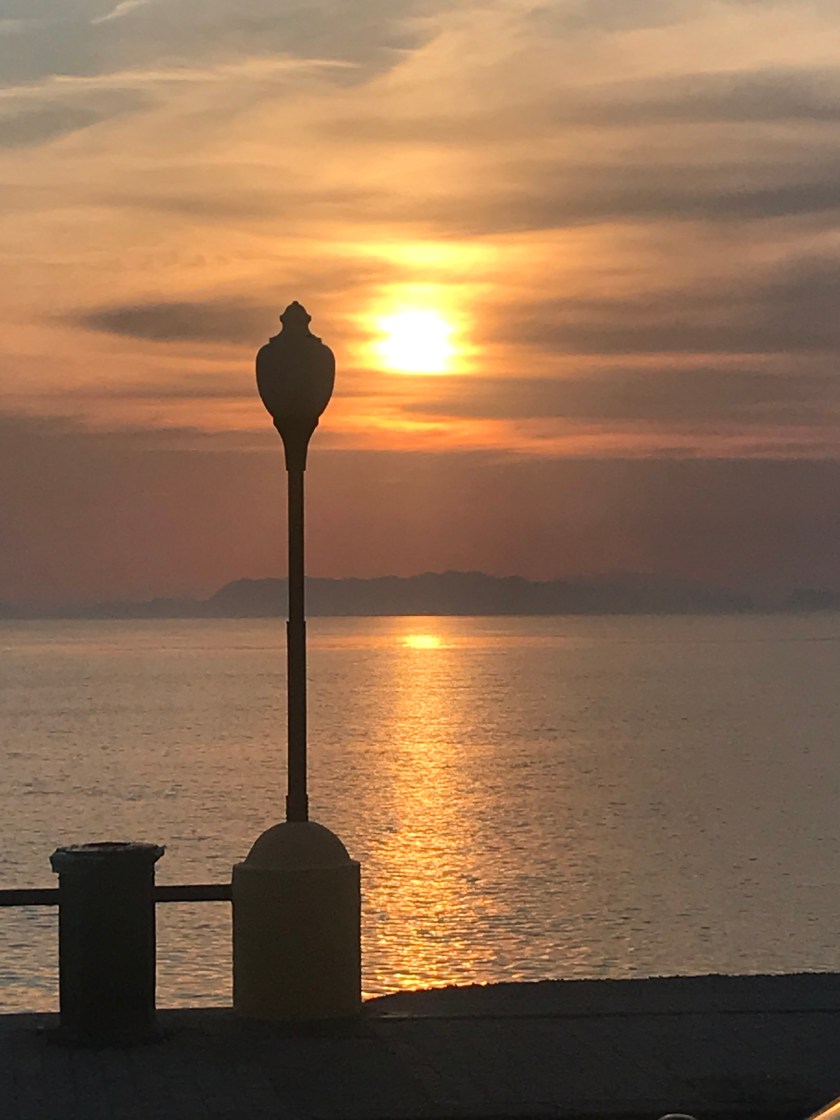
We have a quiet evening where it’s warm enough to sit on the balcony for a final beverage and enjoy the sunset.

We will drive to Dubrovnik tomorrow morning to end our Balkan tour which has been just marvelous.

Western Balkans Part VI : Croatia 🇭🇷

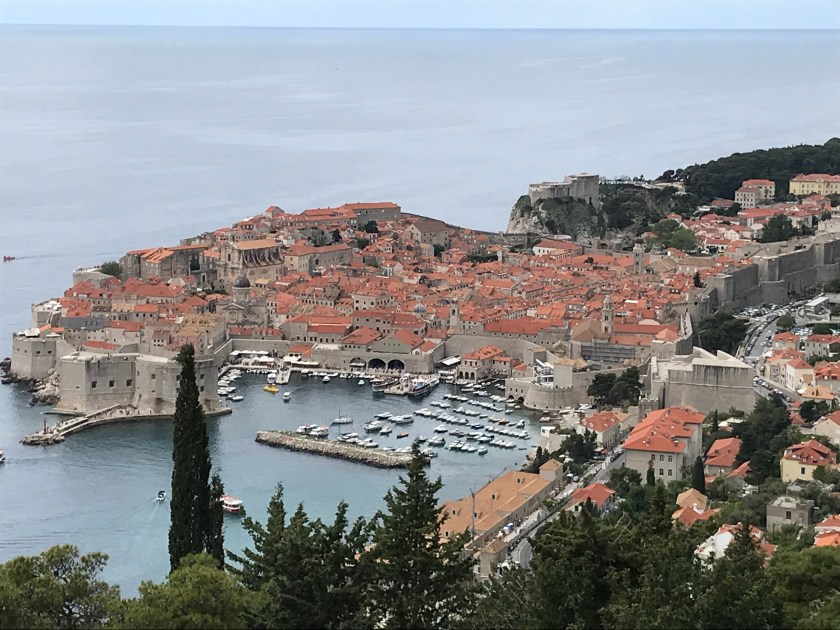
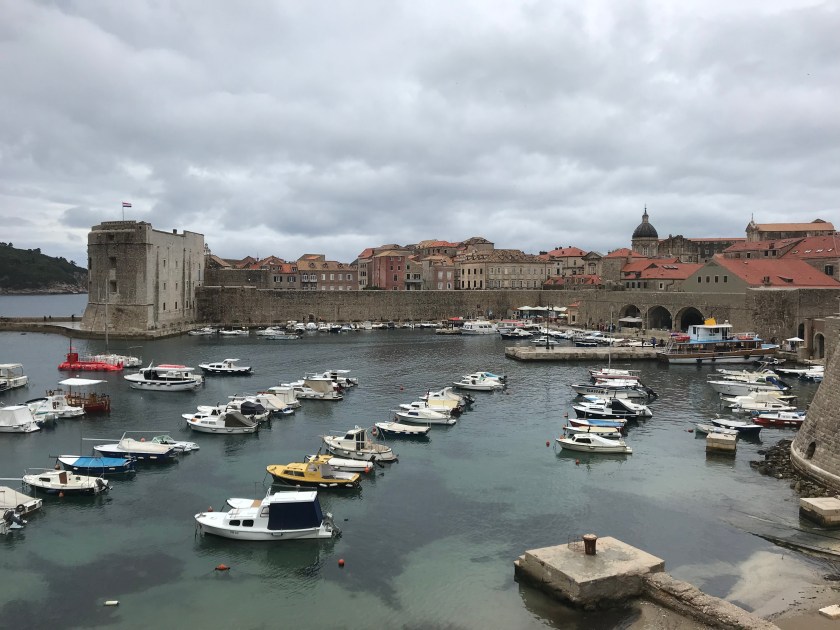
Today we have the last border crossing of the Intrepid trip – a few hours drive from Kotor to Dubrovnik. The coastal drive along the Montenegrin and Croatian coastline is stunning and it’s not long til we get our first view of the city of Dubrovnik:

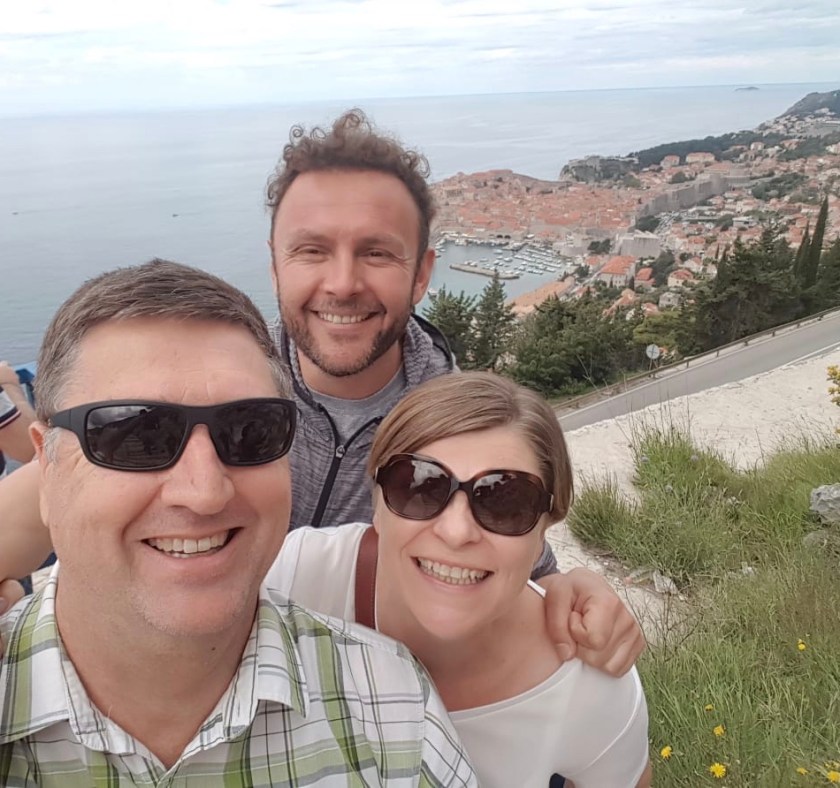
With our guide Bashkim:

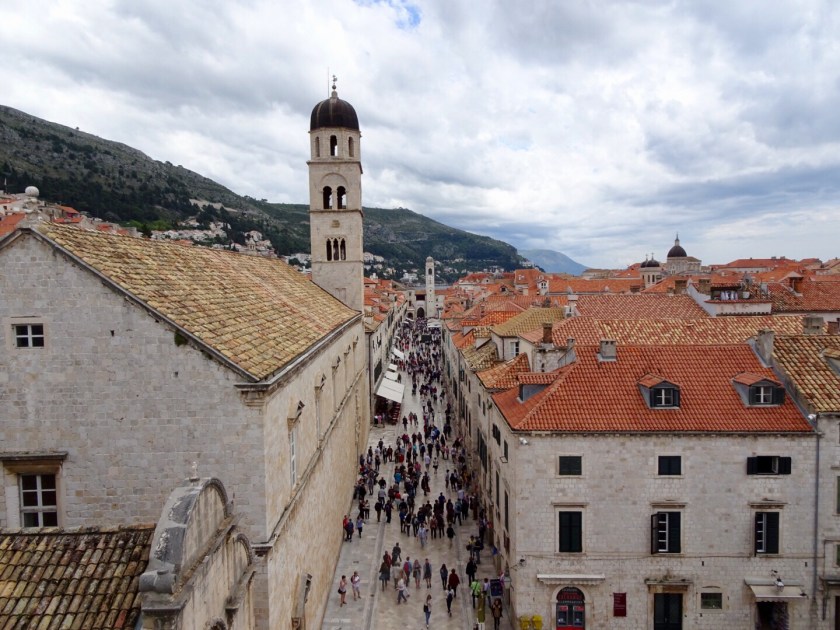
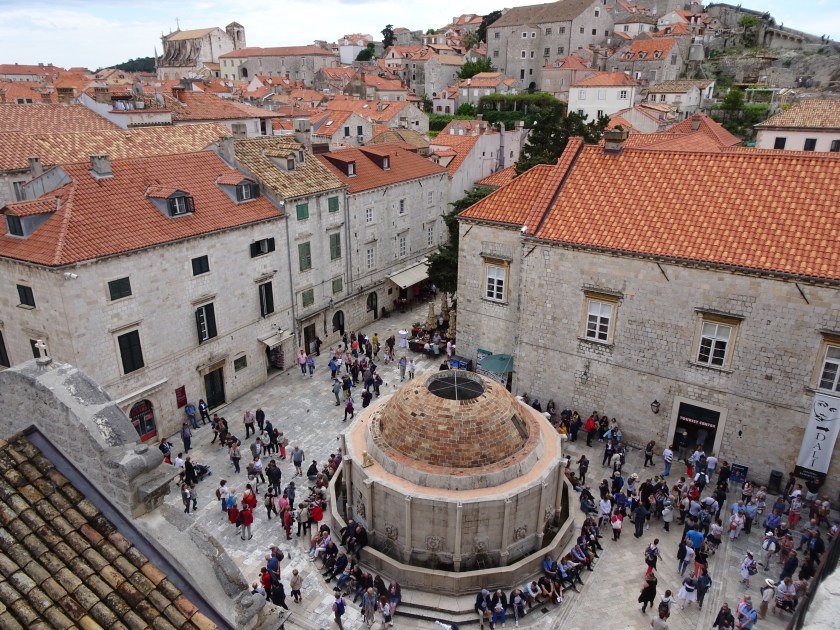
We’re staying in Lapad which is about a fifteen minute bus journey from Dubrovnik old town. We drop our bags and are anxious to get into town as we need to see as much as possible in one day. We have a 1-day Dubrovnik card which gets us 24 hours travel on the bus and entry to walk the walls and some other museums. We arrive into the pedestrianised area within the walls:

From above you can see the large water fountain which I promptly fill my water bottle from.. yes that big round thing has water fountains all the way around!

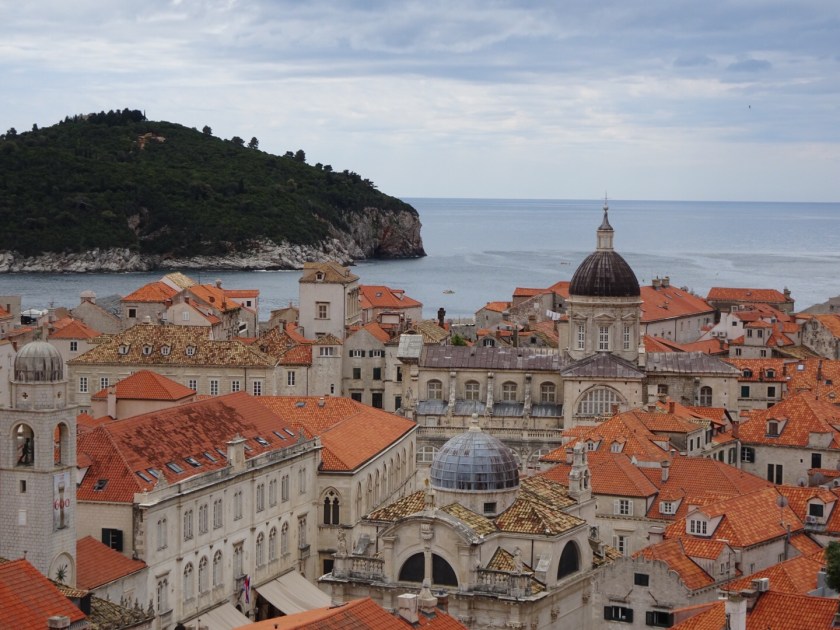
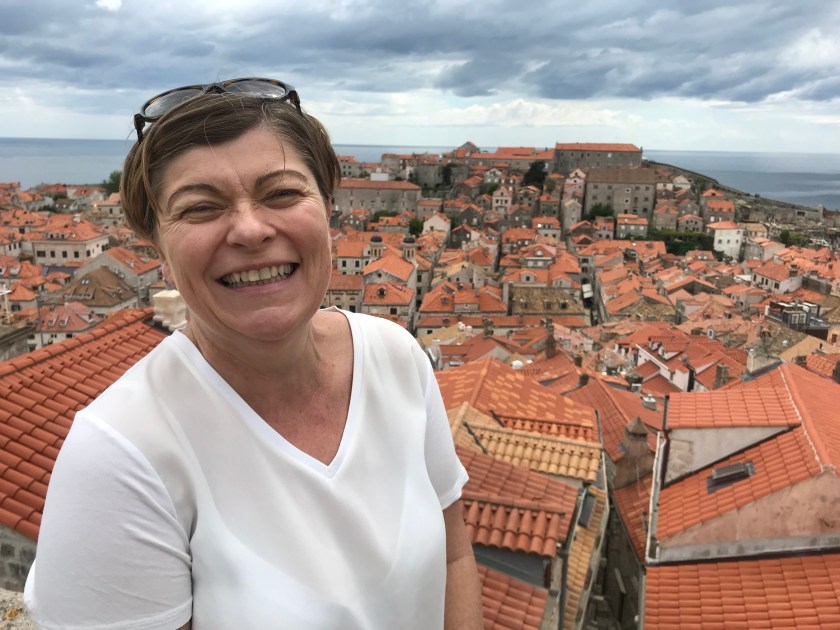
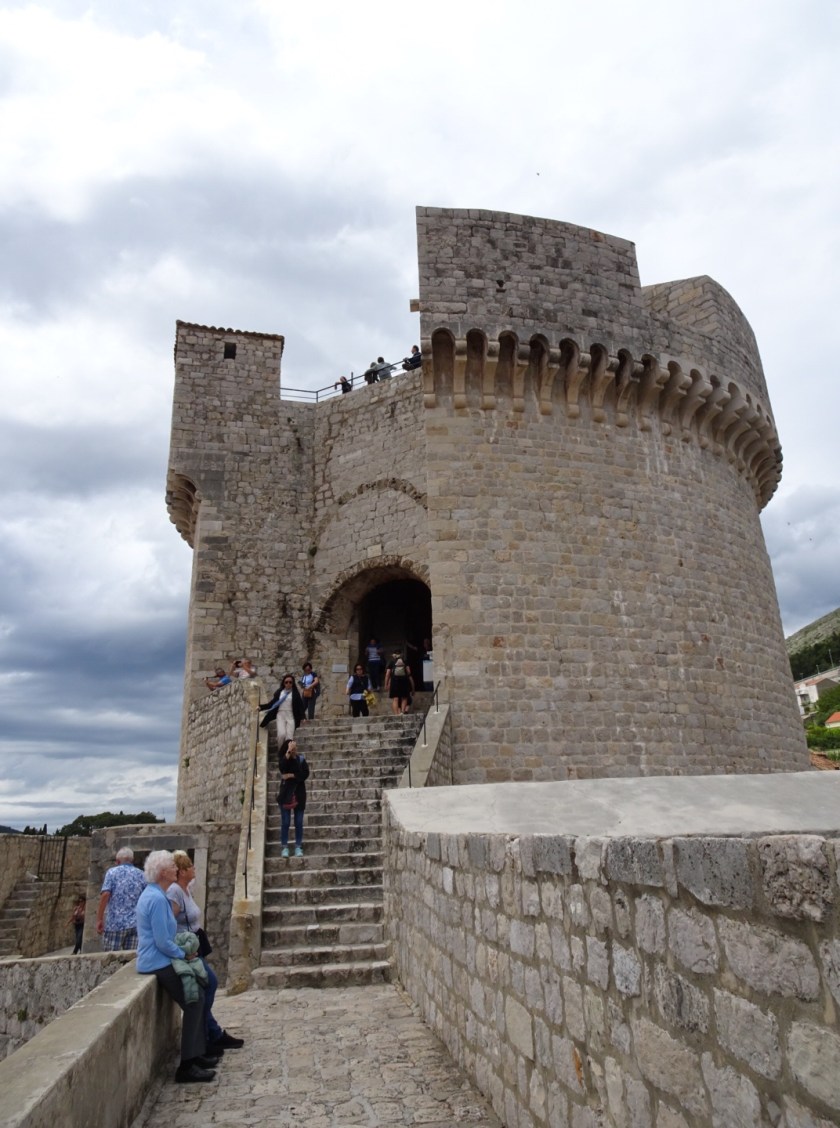
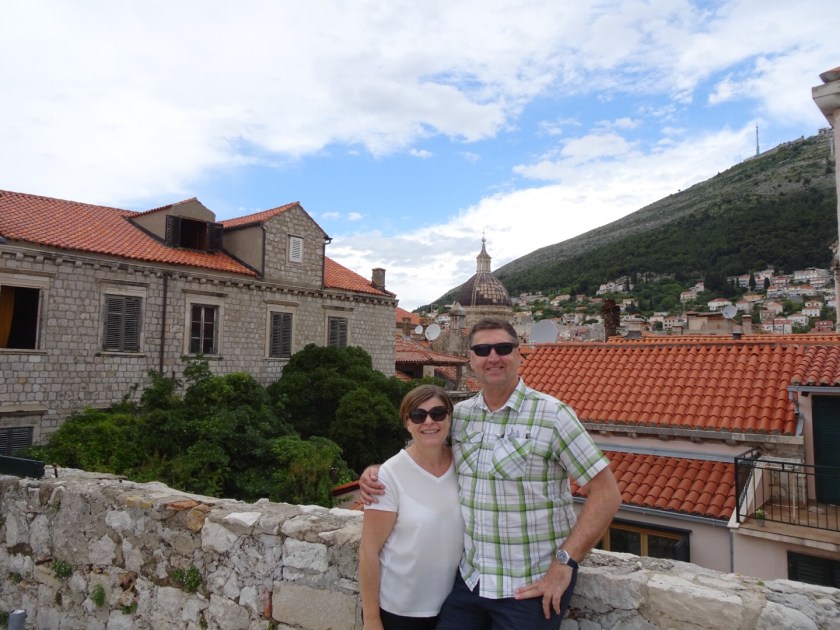
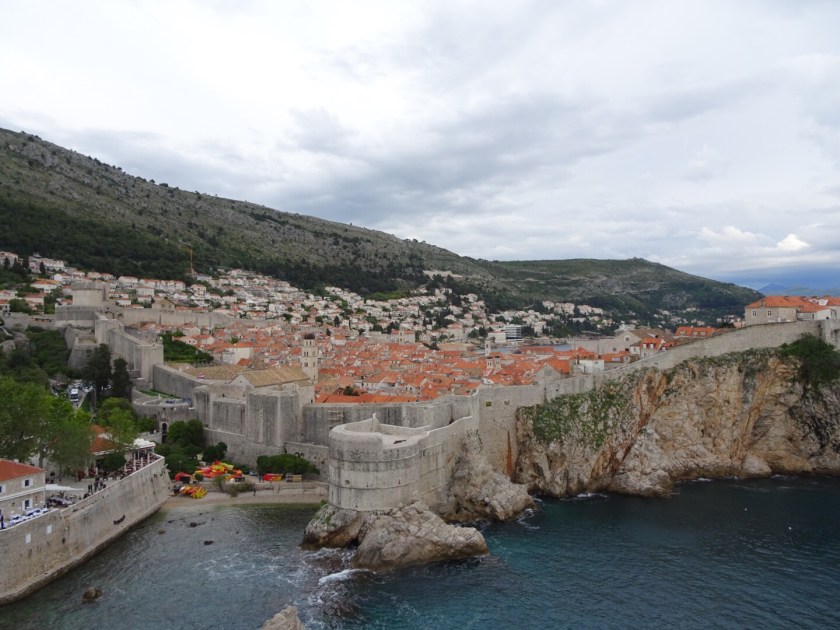
We start by walking the walls which provides so many good views from different perspectives:

I was afraid this very popular town might not live up to the hype but I’m really thrilled to be here and it certainly lives up to its reputation.

Although it’s a lot busier here than anywhere we’ve been, we’re lucky that it’s not too overrun with hordes and we walk around in relative comfort.

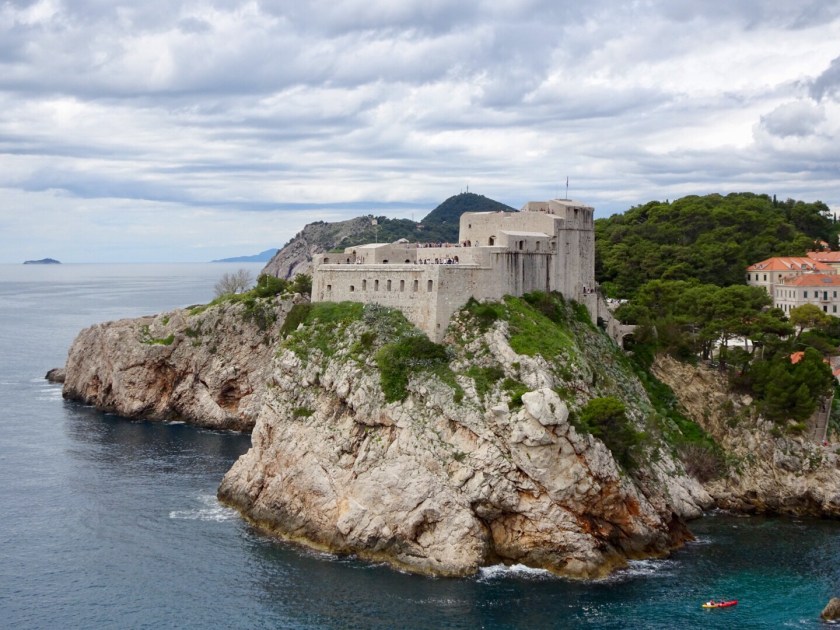
The views are amazing every each way you look… this is the view over to Fort Lovrijenac which we’ll climb to the top of later:

We’re so lucky the rain has held off and it’s sunny as we complete the full walk (about 2kms) of the walls.

We spend the afternoon walking around the old town which has cool narrow side streets with lots of restaurants, bars, cafes, museums and souvenir shops but there are also lots of homes here.

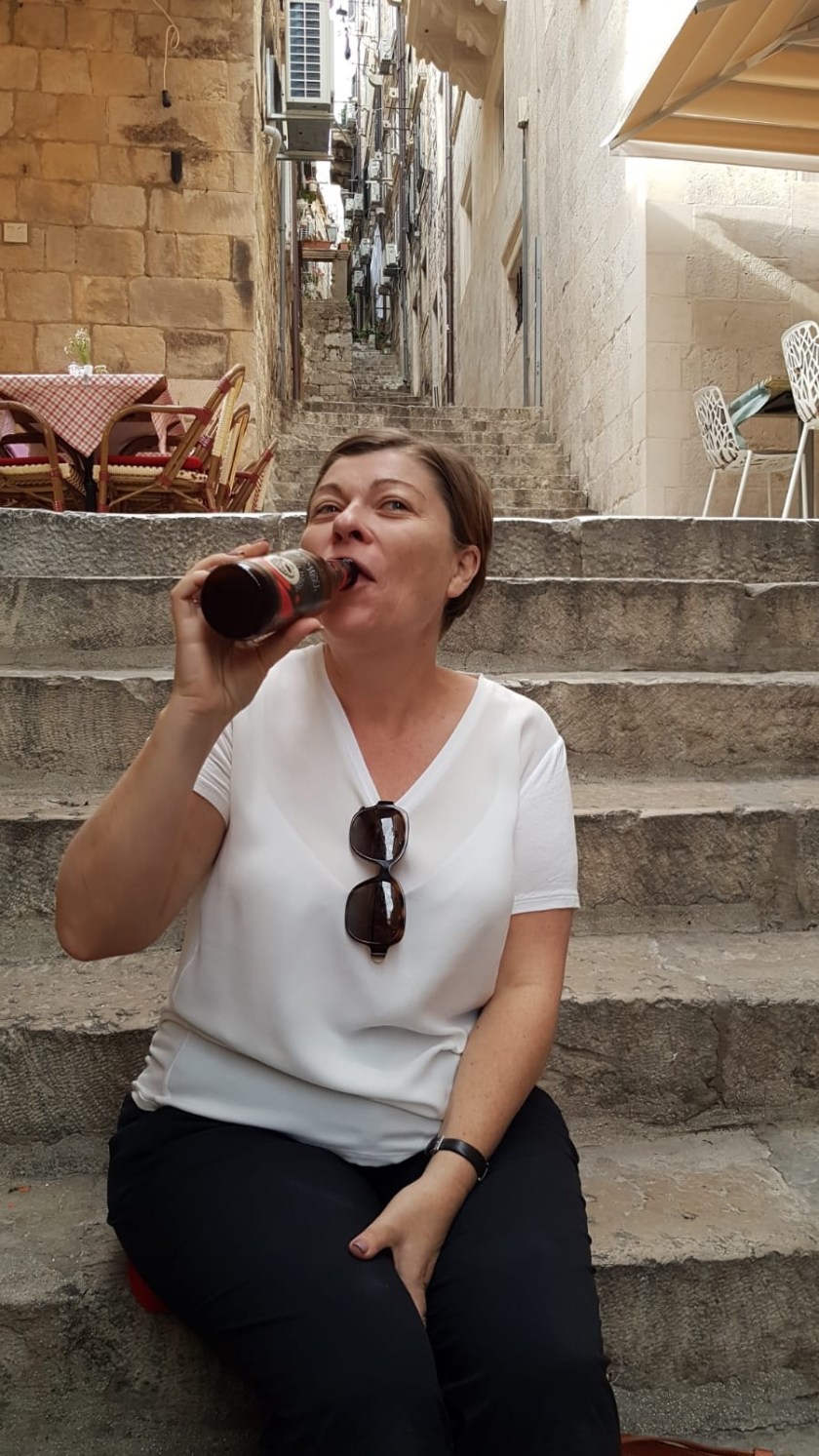
We even stop for a little refreshment and we can sit outside on the steps:

Game of Thrones is popular around here!! We see people walking around with bags from the “official merchandise” shop! I’ve never seen it but I do know some scenes were filmed here in Dubrovnik. Apparently these steps were in a scene:

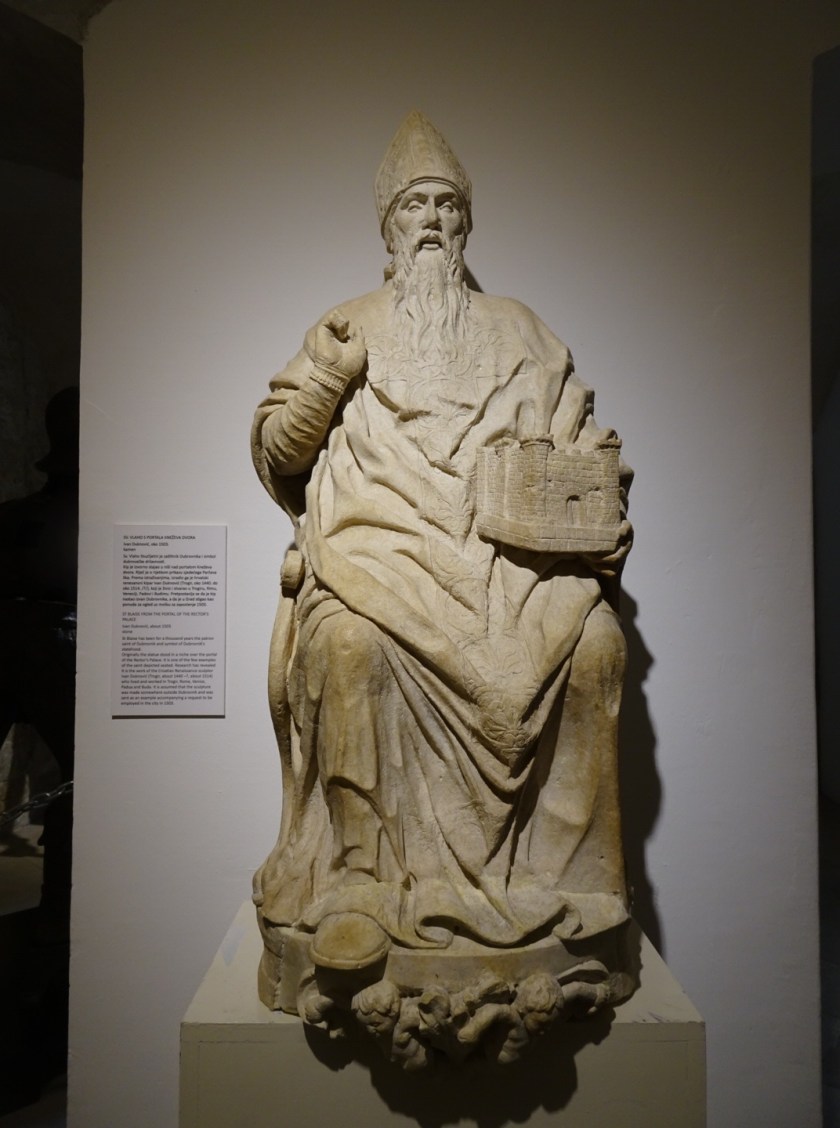
St Blaise is the patron saint of Dubrovnik and he is everywhere…. Whether it’s a statue or a painting he is easy to recognize as he’s holding the walled city of Dubrovnik in his hand.

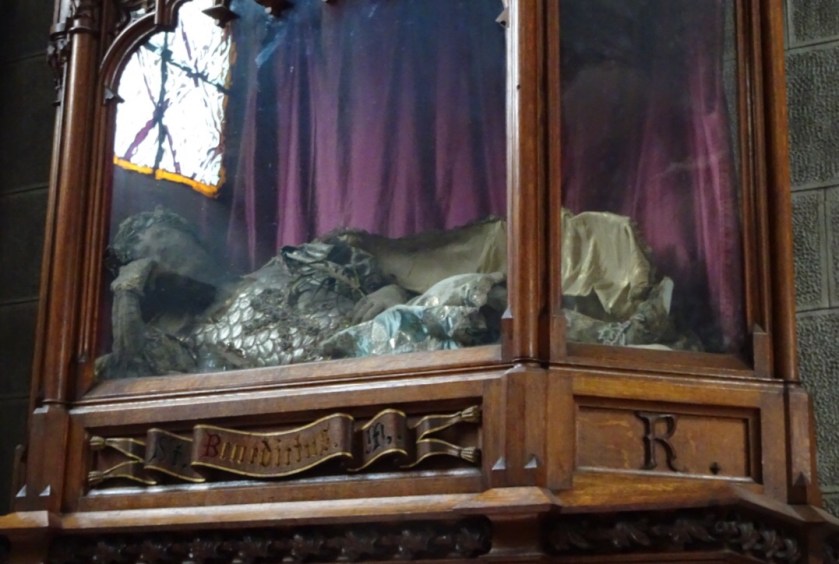
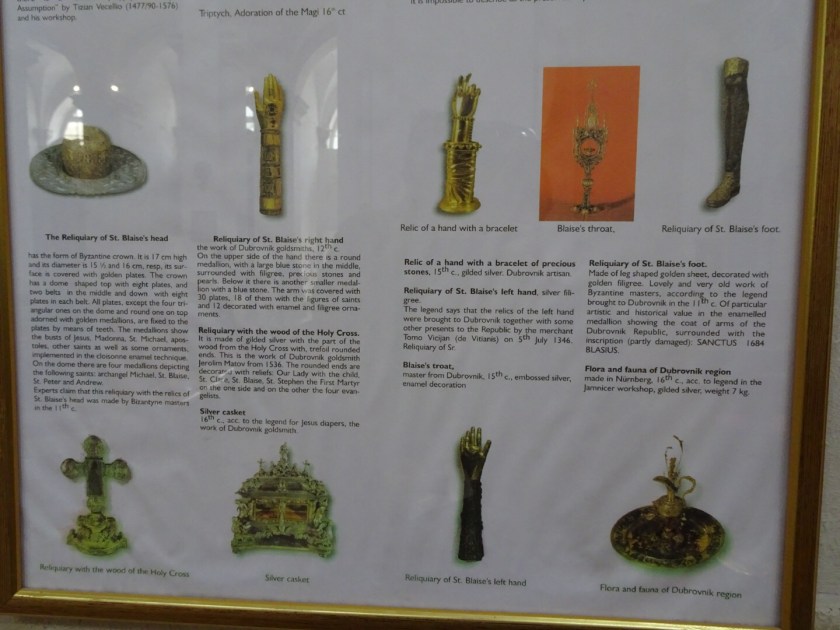
We visit the cathedral which has relics of St Blaise which we visit for €3 in the Reliquiary Treasury behind the alter. No photos allowed but below gives you an idea of what we saw… I particularly “liked” his left arm as you could actually see the bone!! I also had a flashback of queueing up in my local church, in the early 80’s, to have my throat blessed as he’s also the patron saint of sore throats! I wonder does that still happen.

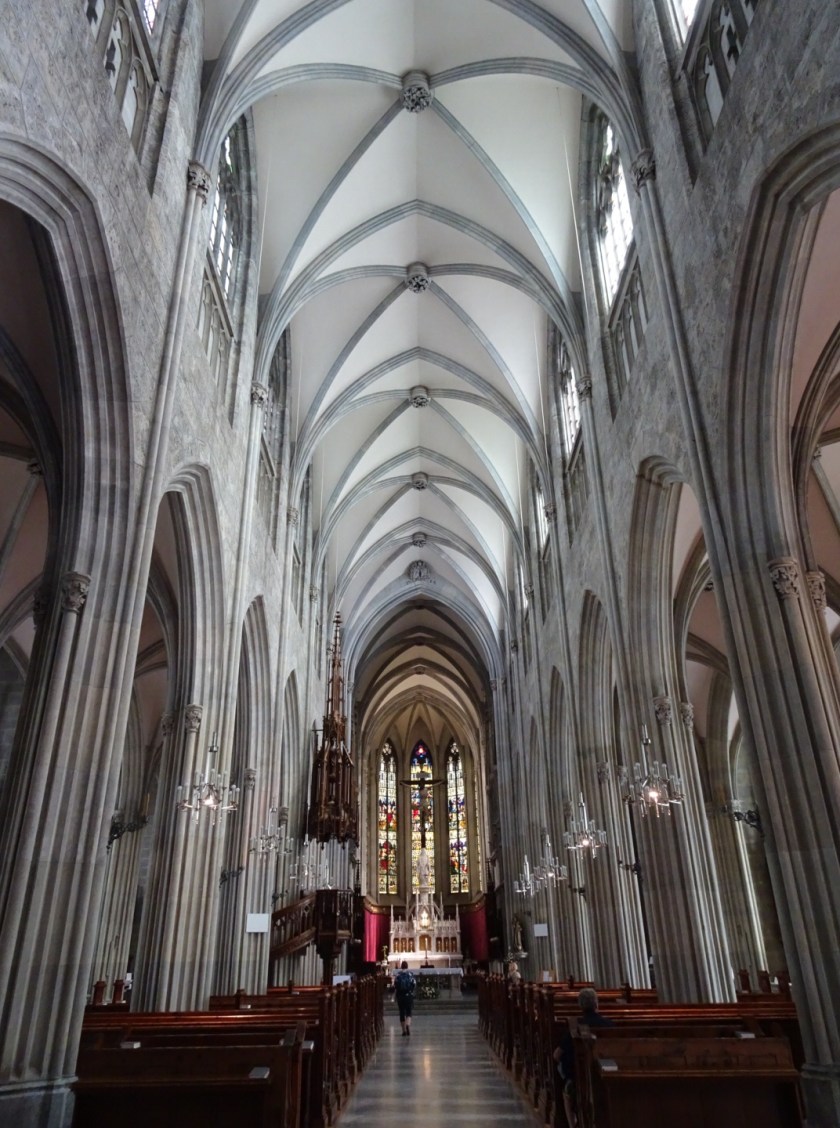
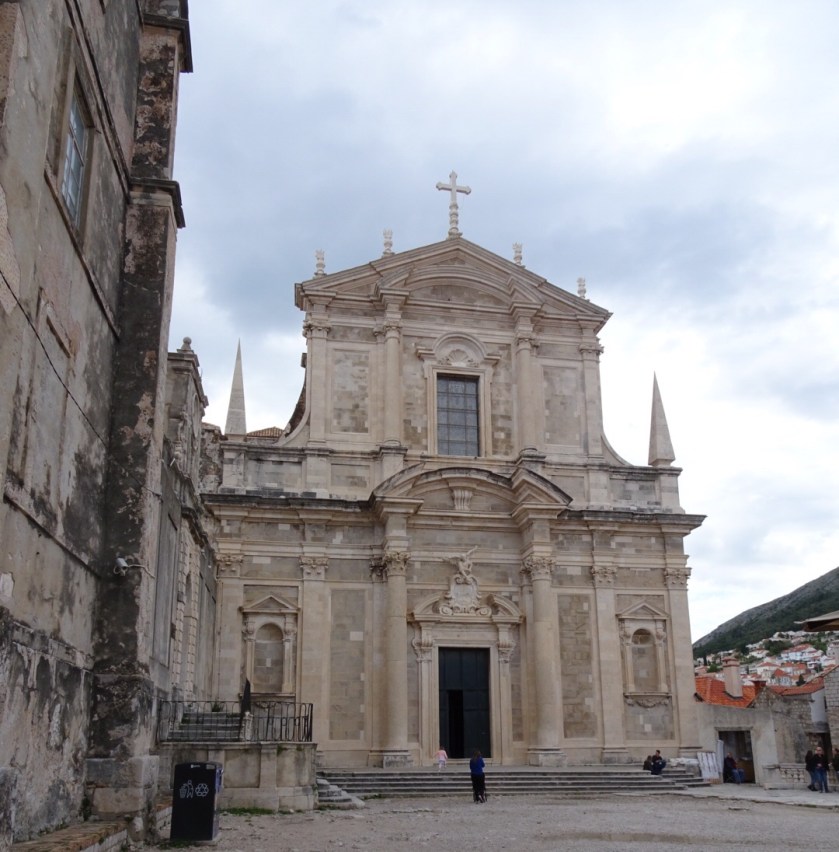
There are many churches within the walls including the Dubrovnik cathedral and the Church of St Blaise.

We check out the Rectors palace which is now the Museum of Dubrovnik and I see an unusual looking bust of Cleopatra from the 5th century

As we make our way toward the main gate there’s a Franciscan monastery, built in the 14th century, with a lovely cloister. On one side of the cloister there is an exhibit of the original pharmacy with journals of drugs and implements for measuring doses etc.

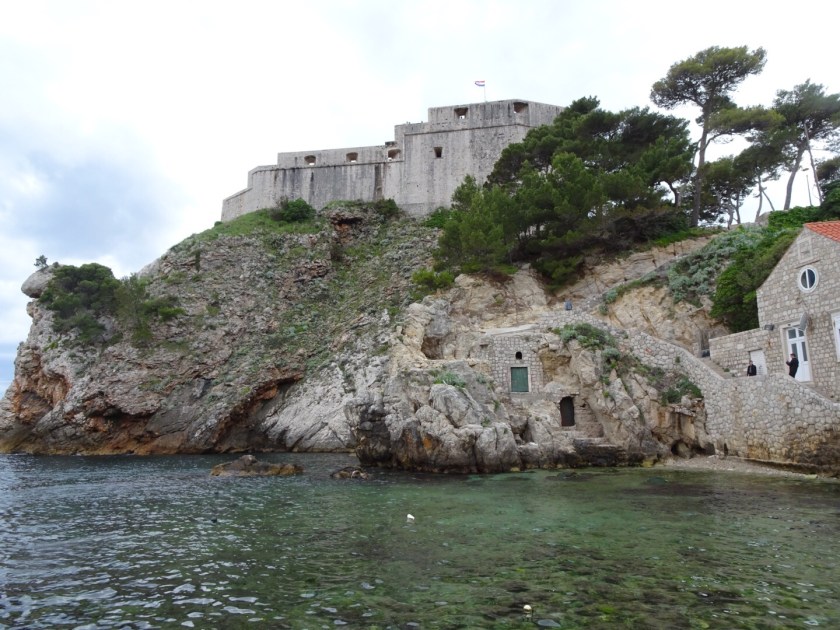
We leave the walled city and head across to climb to the top of Fort Lovrijenac:

Looking back to the walled city from Fort Lovrijenac:

We head back to Lapad for our final dinner with our group and you’ll never guess what I have again… chevapi although in Croatia it’s chevapcici! I can’t get enough of it!

Next morning it’s one last look at this beautiful city before we pick up a car and head further up the coast

Western Balkans Part V : Montenegro 🇲🇪

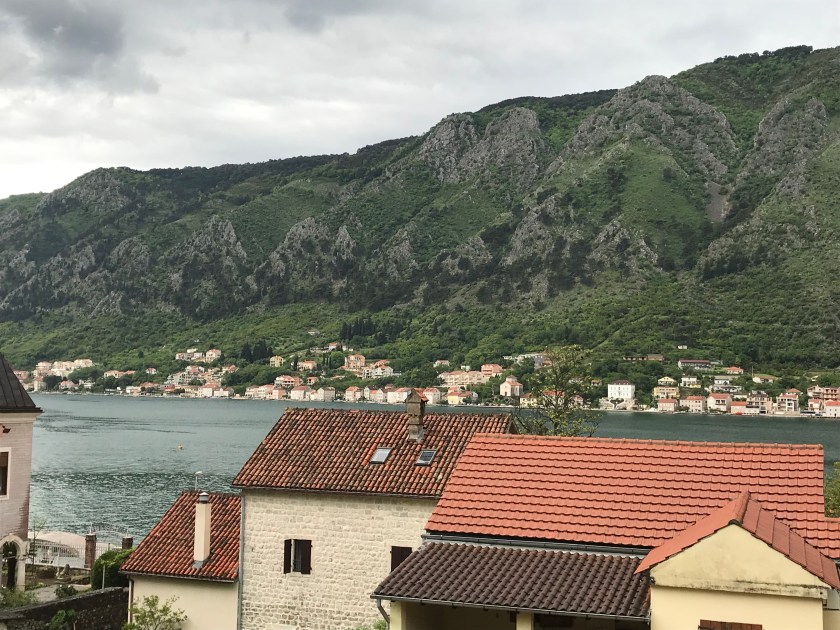
Onwards to Kotor, Montenegro’s fortified town wedged between soaring mountains and the Adriatic sea. Kotor is a UNESCO World Heritage-listed city dating to the 5th century. We have two nights here but the weather is not cooperating and unfortunately it’s going to rain most of the time we’re here. We do have a balcony with a nice view though:

We arrive fairly late in the evening and get a guided walk around the old town…. in the rain!

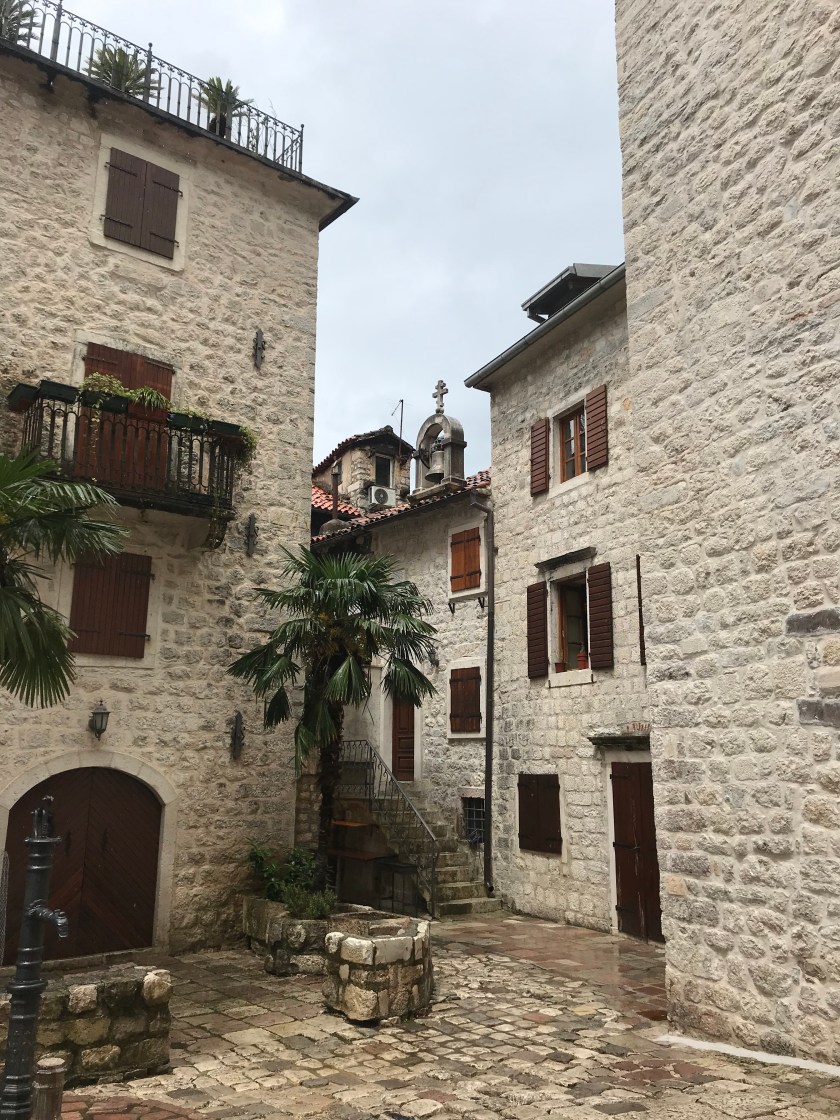
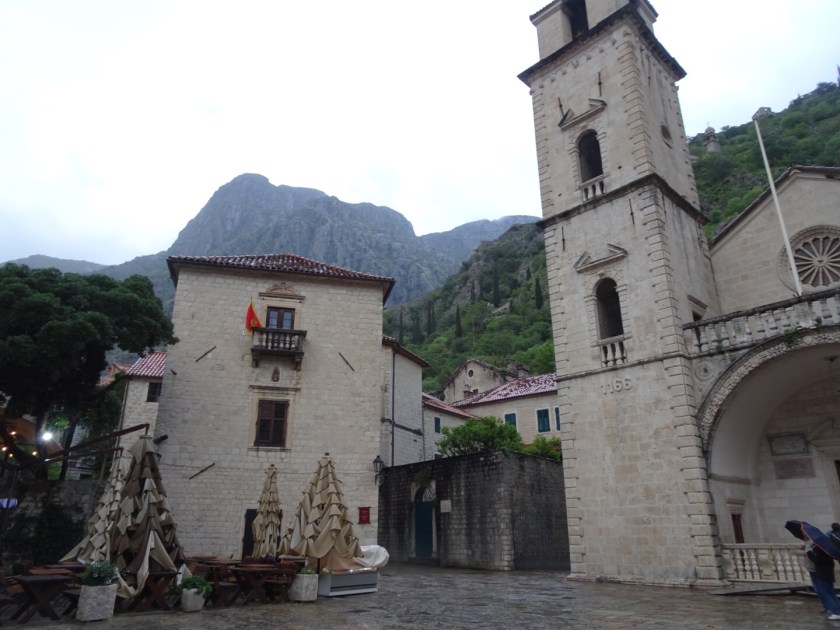
The old town is within the walls with a main square and lots of little narrow streets

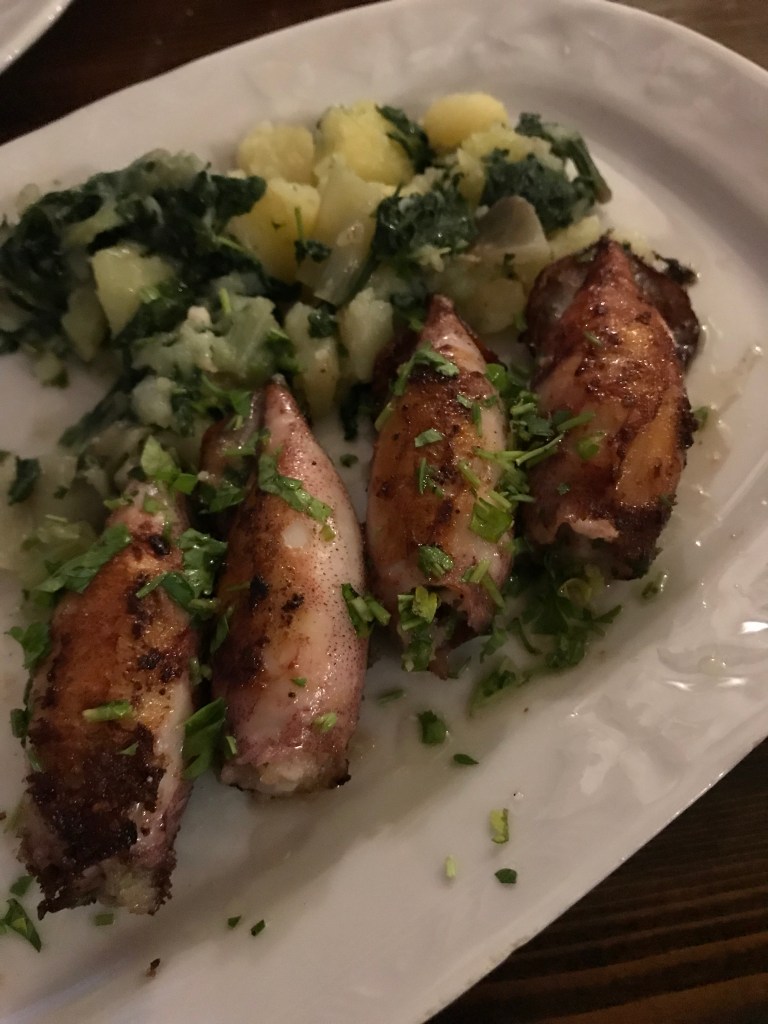
Another restaurant recommended by Bashkim results in a fabulous meal of stuffed squid and black ink risotto. It’s called Cesarica and it’s like a stone cave off a little side street. I’d never had stuffed squid before and it was gorgeous:

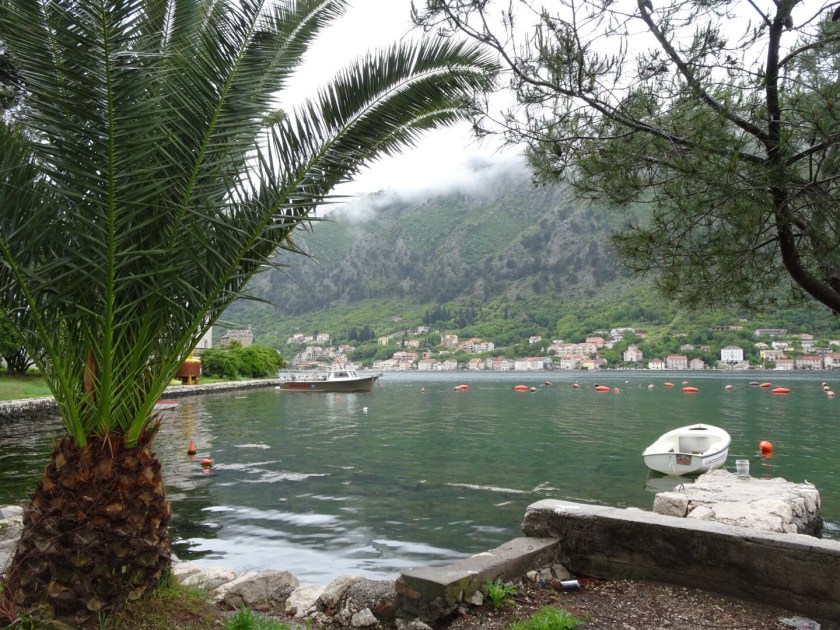
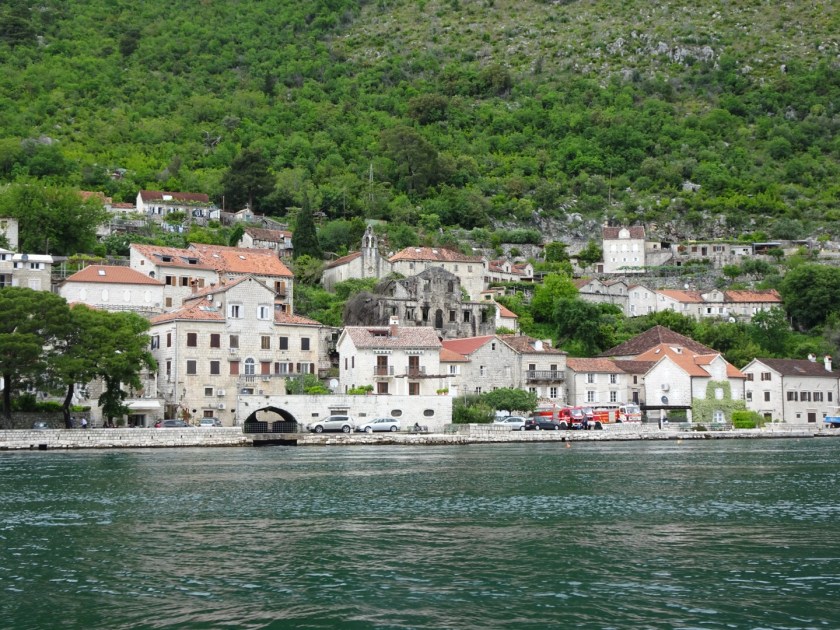
Next morning it’s raining heavy so we relax for a while before putting on our raincoats and heading back to the old town between showers. The hotel is about twenty minutes walk away but there’s a beautiful walkway along the water …

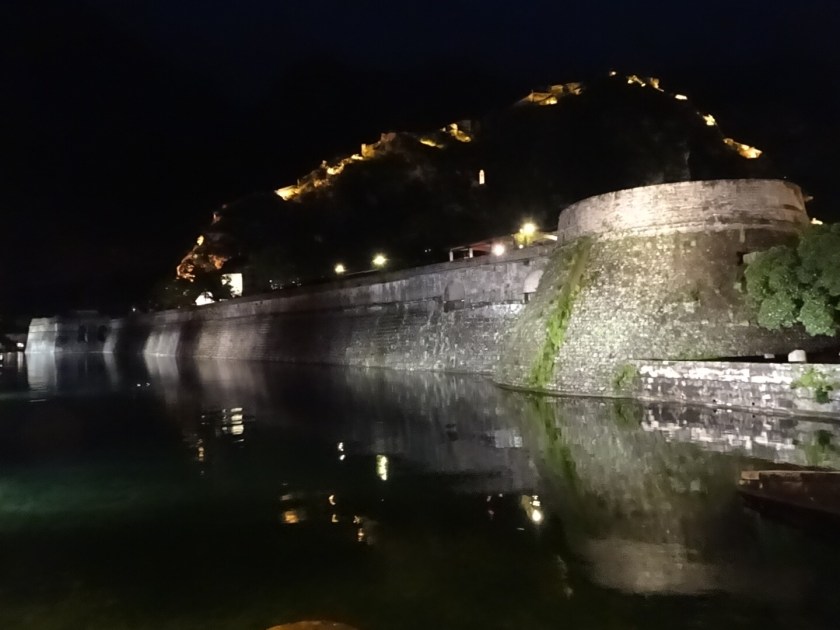
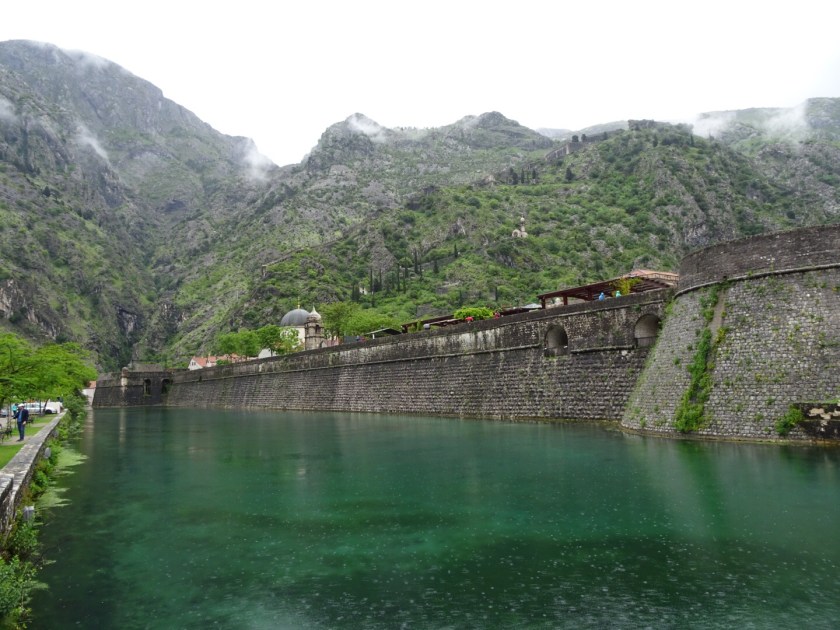
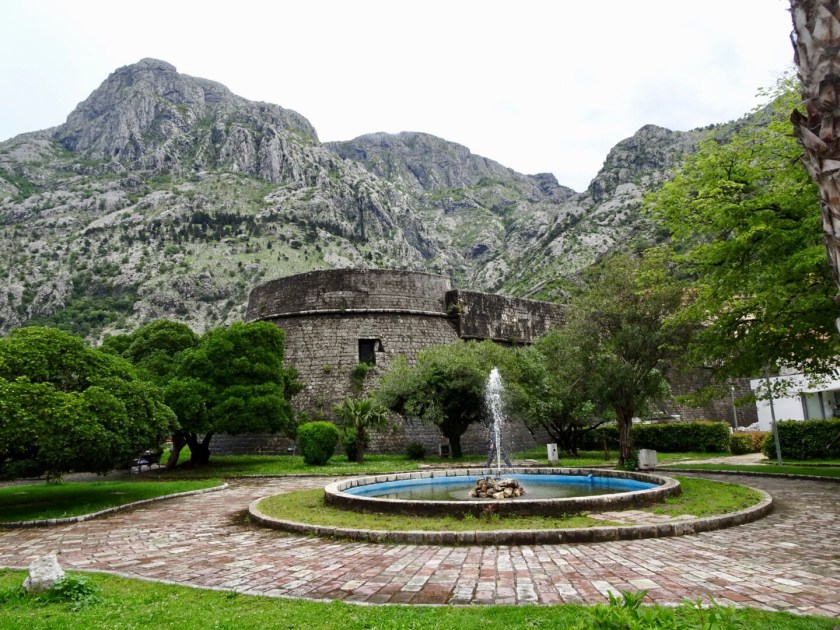
The walls of the old town are very impressive:

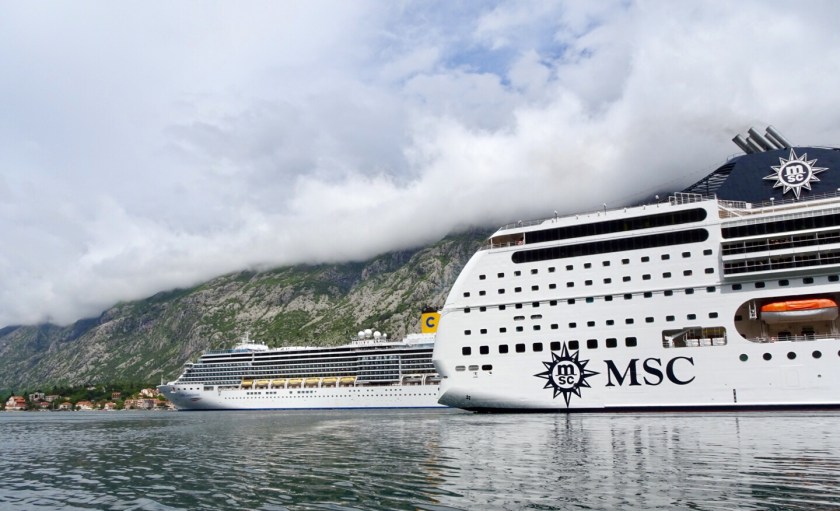
We haven’t seen a lot of tourists to date on the trip but we do see a fair amount here in Montenegro. The town gets overrun in the summer from the cruise ships but we’re early enough in the season that it’s not too bad.

This afternoon we take a boat on the Kotor Fjord. The weather has brightened up and the views are stunning:

We pass a cruise ship coming into the bay, passing another on its way out…

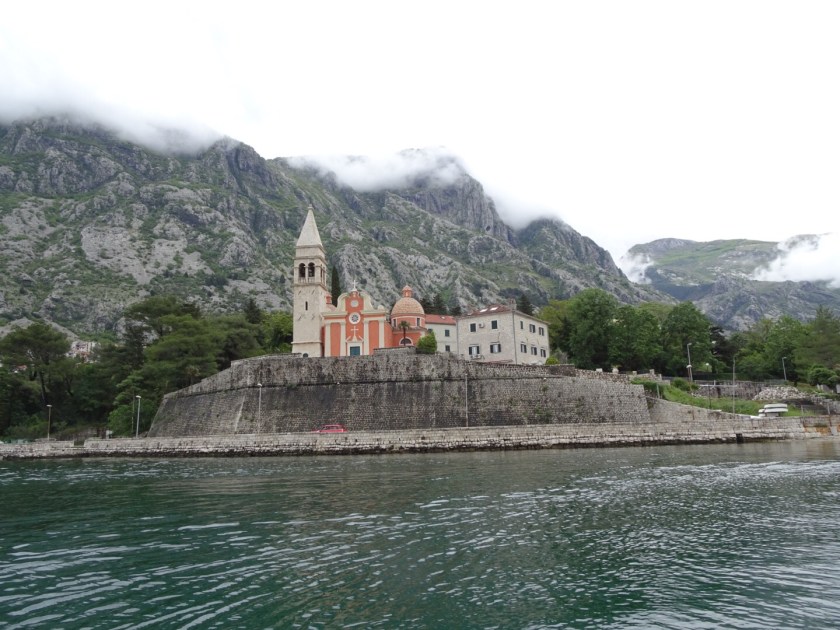
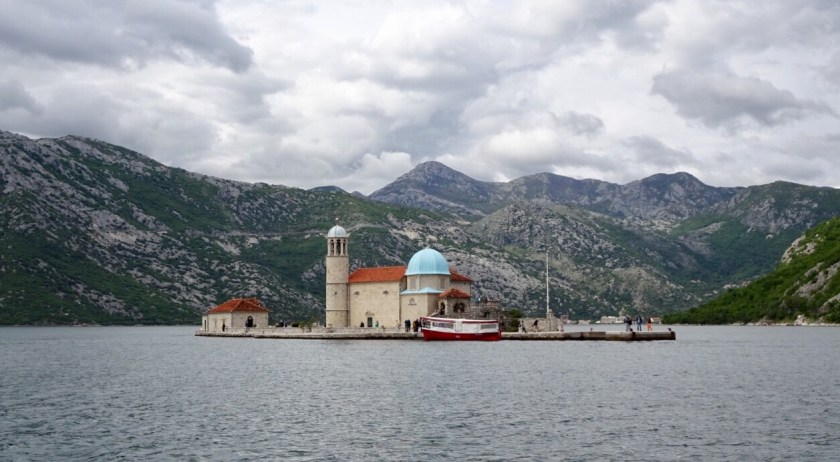
We visit an island with a church that’s almost as big as the island itself. The church is tiny and cute.

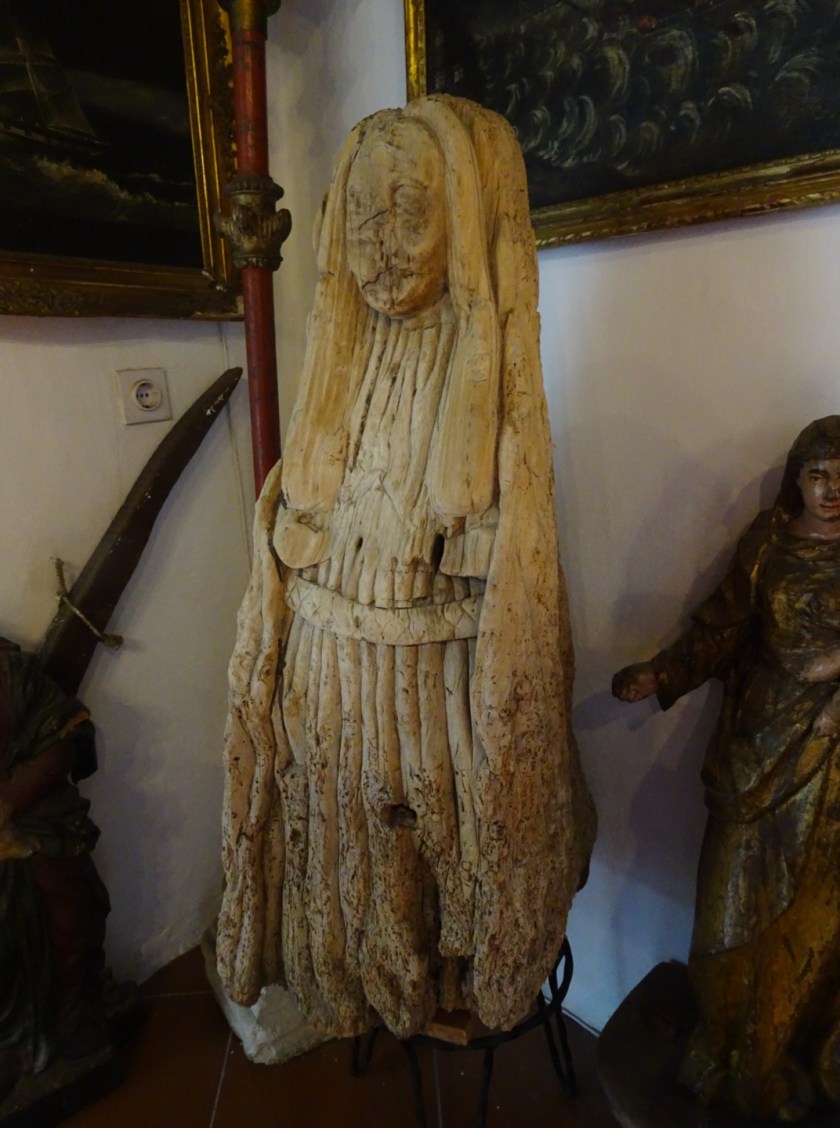
There’s a small museum with a one euro entry fee that helps with the upkeep of the island. It has some interesting stuff! This was the figurehead at the bow of a ship and it reminded me of pirates of the Caribbean!

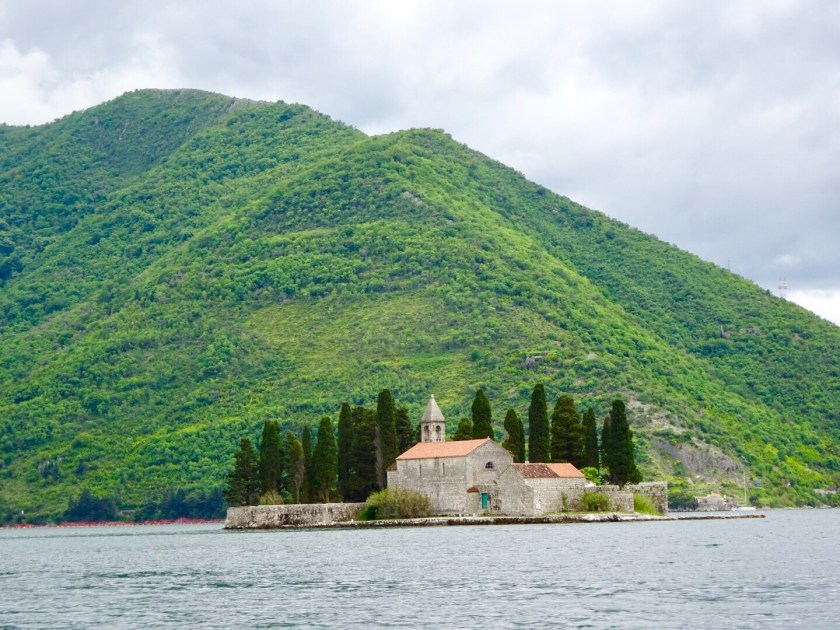
And there’s another island with another church right beside that one!

The boat trip is a real highlight as Kotor is a great place to see from the water. That evening we have a seafood dinner with the group and the next day we move on.

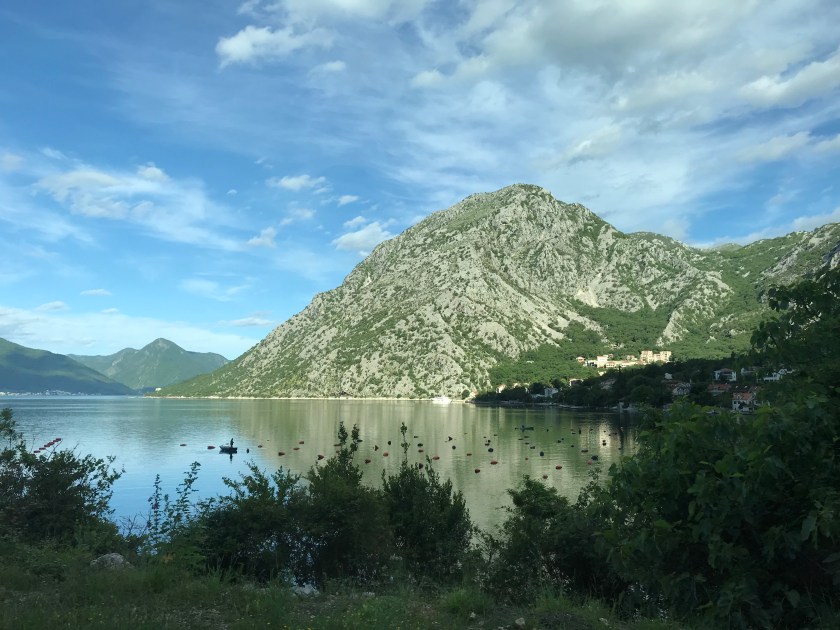
We drive along the coastline en route to Croatia and the views are stunning pretty much the whole way

Western Balkans Part IV : Albania 🇦🇱

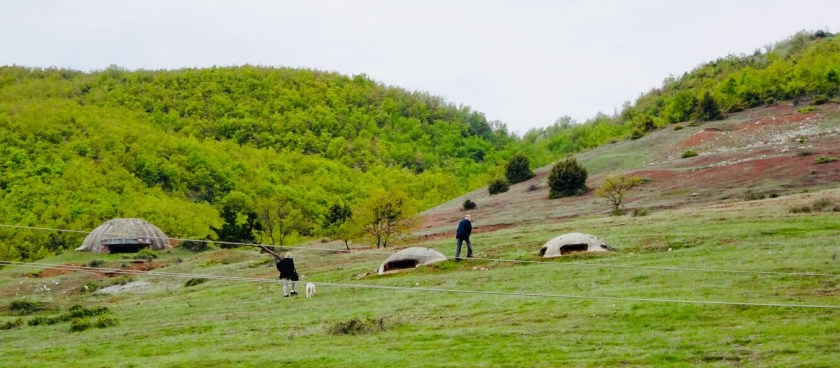
Another border to cross as we set off on the four hour journey to Albania. One of the peculiar things we see are bunkers which are dotted all over the country. They were built by Enver Hoxha who was the communist dictator from 1945 to 1985. Hoxha feared that the USA or some of the neighboring countries would declare war and he wanted to be ready for them – it never happened!

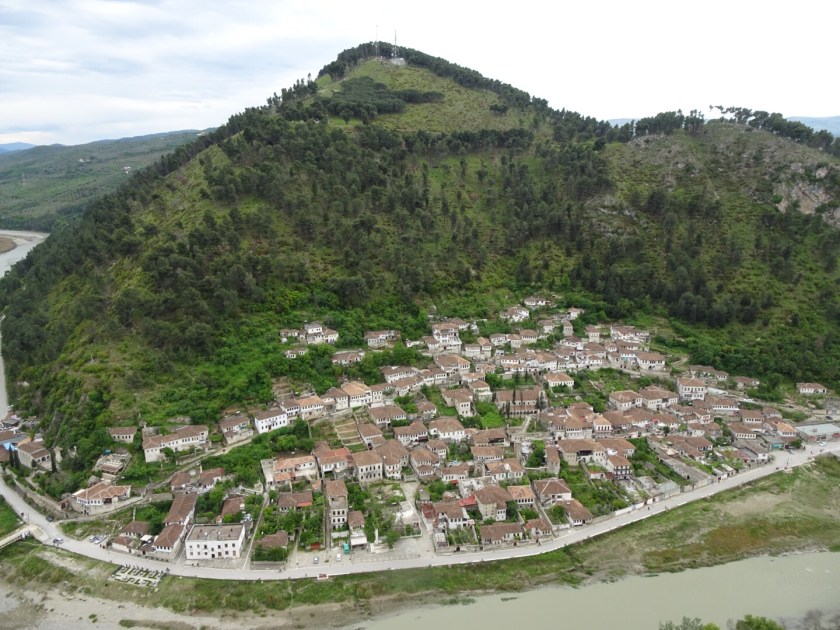
We are overnighting in the rarely visited town of Berat which was lucky to escape destruction during communist times. It’s a small town, built into the side of a mountain on either side of a river.

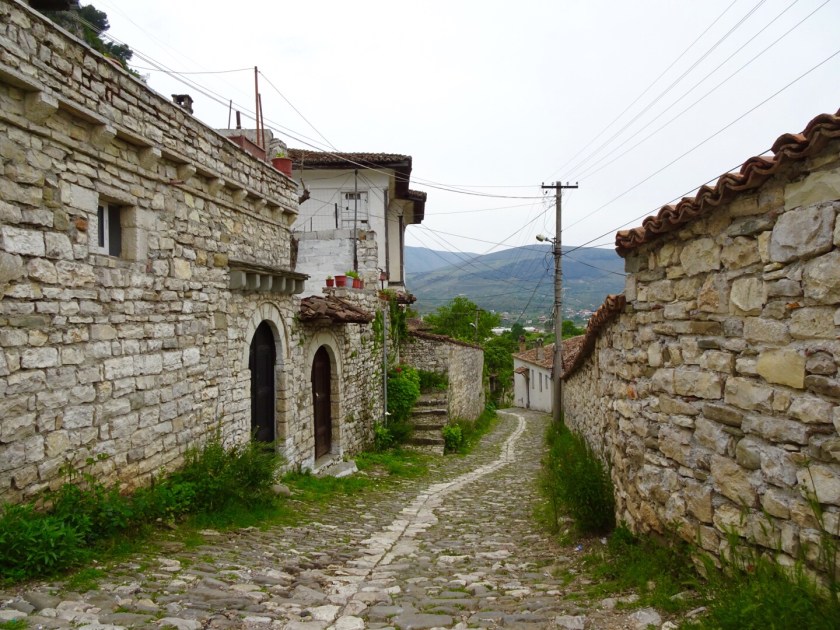
Our hotel is very cute and situated in one of the small cobbled streets.

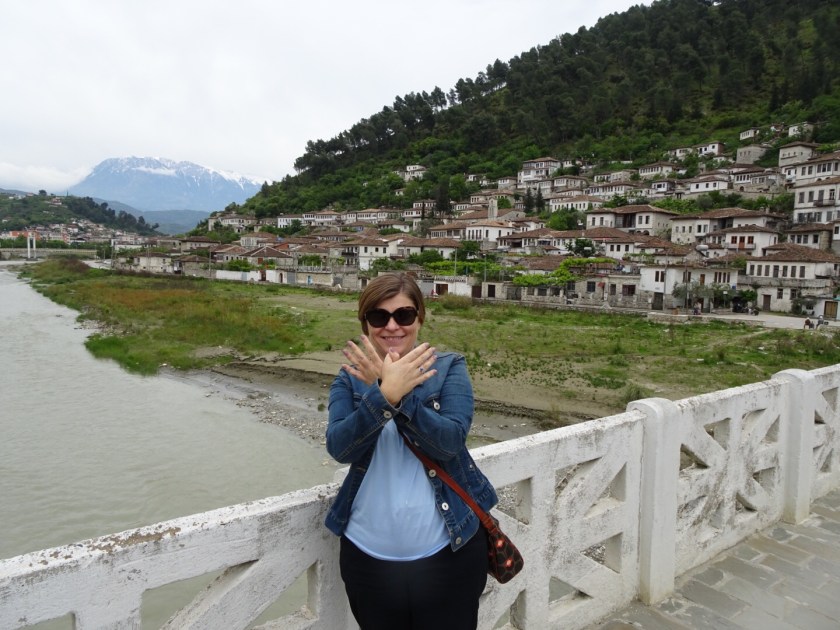
After a quick orientation and lunch (kebab 😋), we set off to explore this picturesque little town. The people of the Balkans love displaying their flags…. me doing the symbol of the double eagle on the Albanian flag:

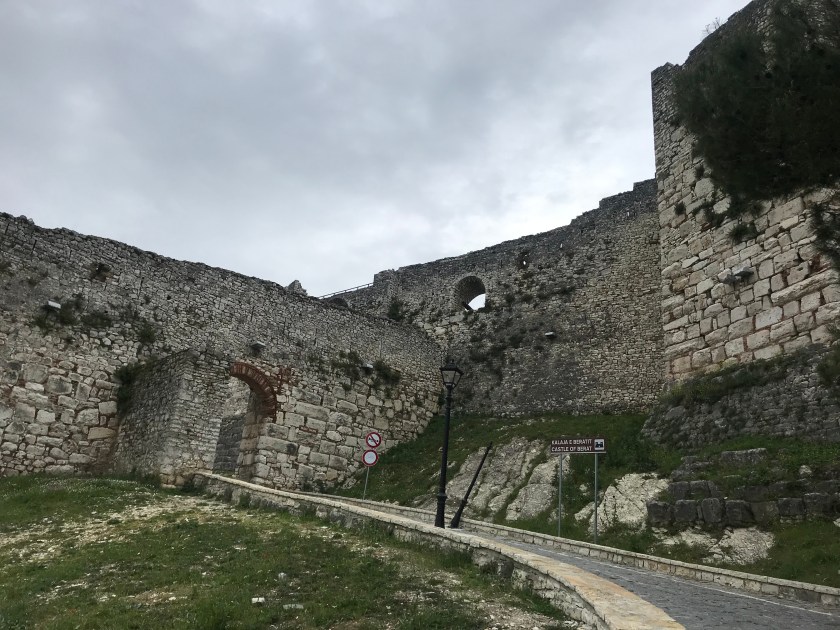
Later in the afternoon we meet back up with our group and Bashkim, our guide, takes us to the fortress at the top of the hill. He explains the history of the town and shows us the letters NEVER that are etched into the side of another mountain. Apparently they used to read ENVER (the aforementioned dictator) and they were recently changed! Entrance to the fortress:

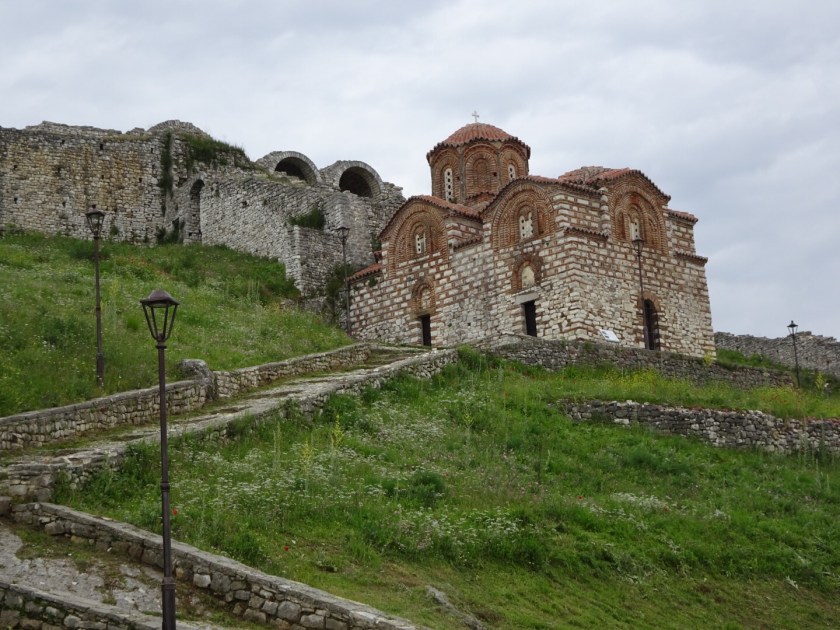
There are a number of old churches in the fortress grounds, this one being the best located:

A couple of other older churches (all Orthodox) have some interesting frescoes and we are able to take photos as they’re no longer working churches:

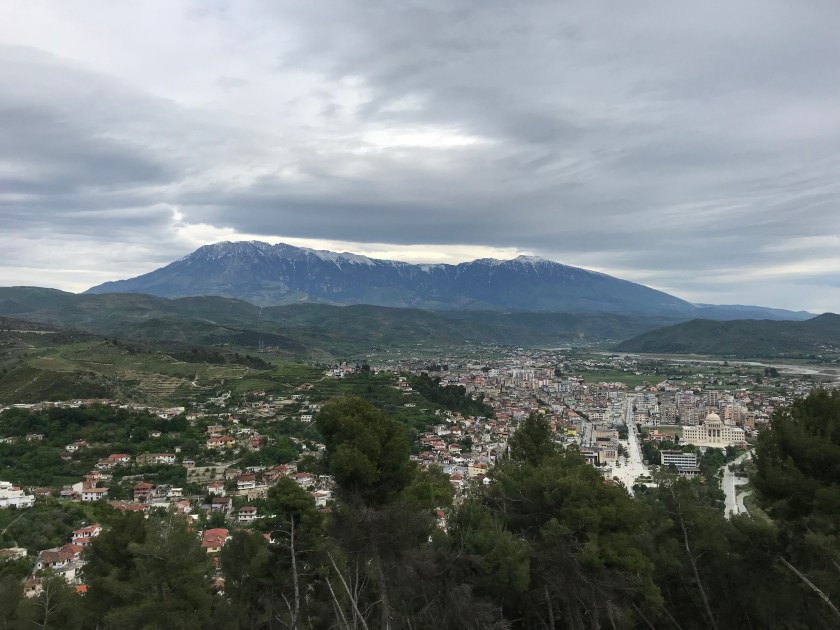
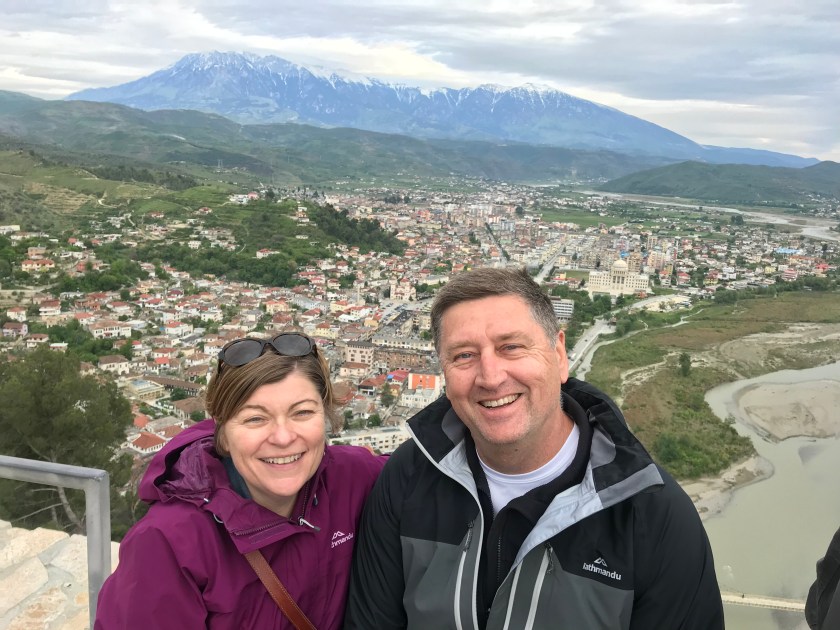
There are fantastic views from the top of the mountains and the town…

In the evening we enjoy a traditional Balkan dinner with our group. Our guide orders a variety of dishes so we can sample everything and we also try some locally produced wine. It’s all really tasty, in particular a dish called chomlek (a type of pork stew) and the roasted cheese….. so tasty! The wine is really good too. After dinner we take a walk on the promenade which is a pedestrian area full of bars and restaurants.

Next day after breakfast, we transfer to Tirana, the capital of Albania. The journey takes approx. three and a half hours. On arrival, we embark on a guided tour to get our bearings for the next couple of days. Although Tirana is the capital and the biggest city, it’s still small and compact, and has architectural influences from Italy and Turkey. Recently many buildings have been painted to alleviate the Soviet block feeling that pervaded.

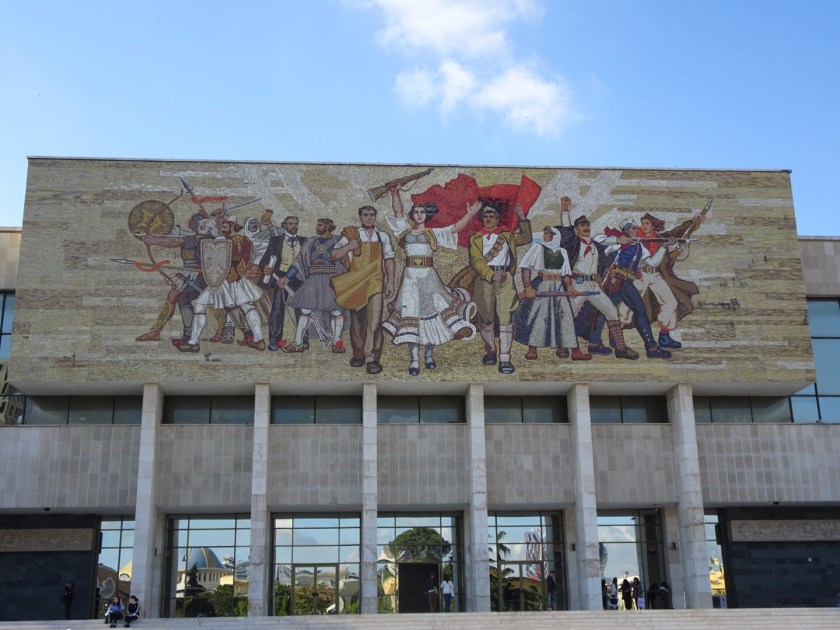
It has a huge main square which is mostly empty but has water sprinklers that are not turned on as it’s not that warm yet. A large statue of a man on a horse (this seems to be a common theme in the balkans) stands opposite the historical museum which has a great mural on the front

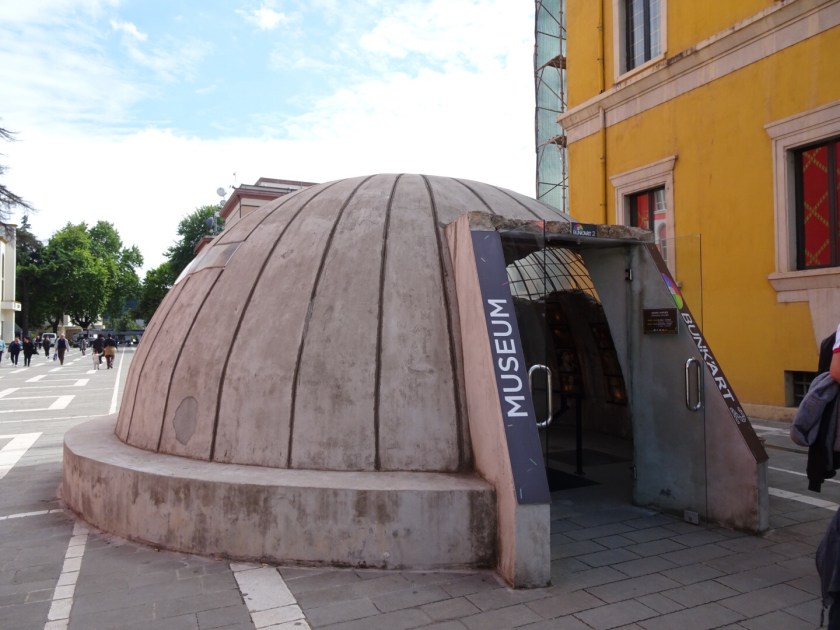
We visit a museum called Bunkart 2 which details the history of the police in Albania and the role they played during the communist era. It’s housed in a bunker (hence the name) but there’s not much art. It’s interesting but dull and somewhat depressing!

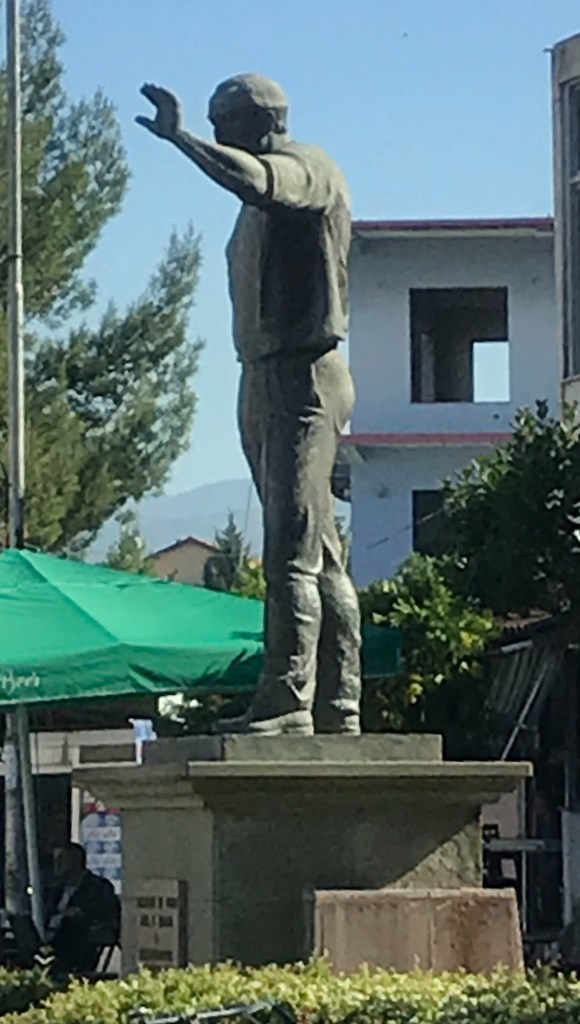
Next morning we take a half-day trip to the mountain village and former Albanian capital of Kruja. On the way we drive through another village that has a statue of George W Bush, a bakery named George W Bush and a cafe with a seat no one is allowed to sit in since the president sat here when he visited in 2007. The Albanian people have a strong connection to the USA as they were a big support when moving from a communist country to a democracy. A major outcome from the US visit was Albania joining NATO in 2008.

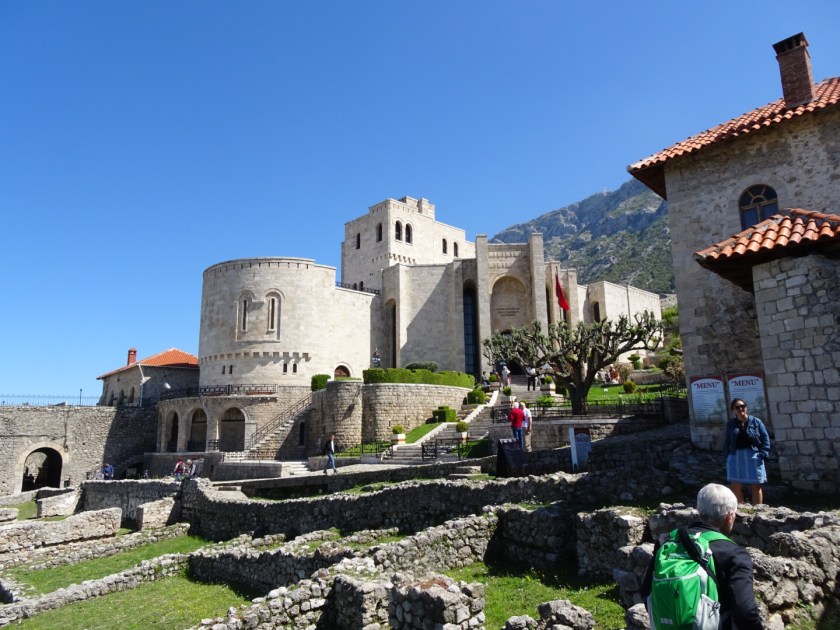
We visit to the ethnographical museum housed inside the fortress and learn about how the Albanian people lived.

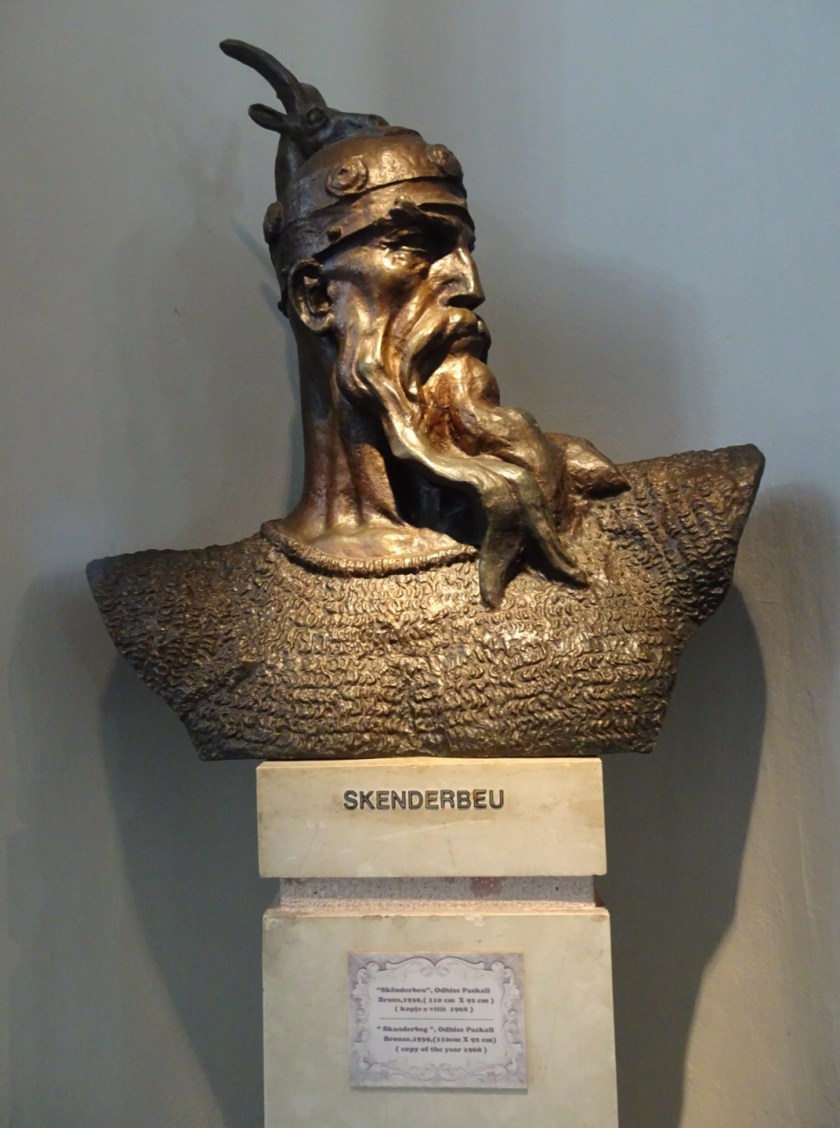
Also within the fortress walls is the history museum where we learn about Skanderbeg – the national hero of Albania. He was educated in Istanbul and fought for the Ottoman empire but ultimately ended up fighting against the Ottomons for Albanian independence. (he was the guy on the horse in the main square)

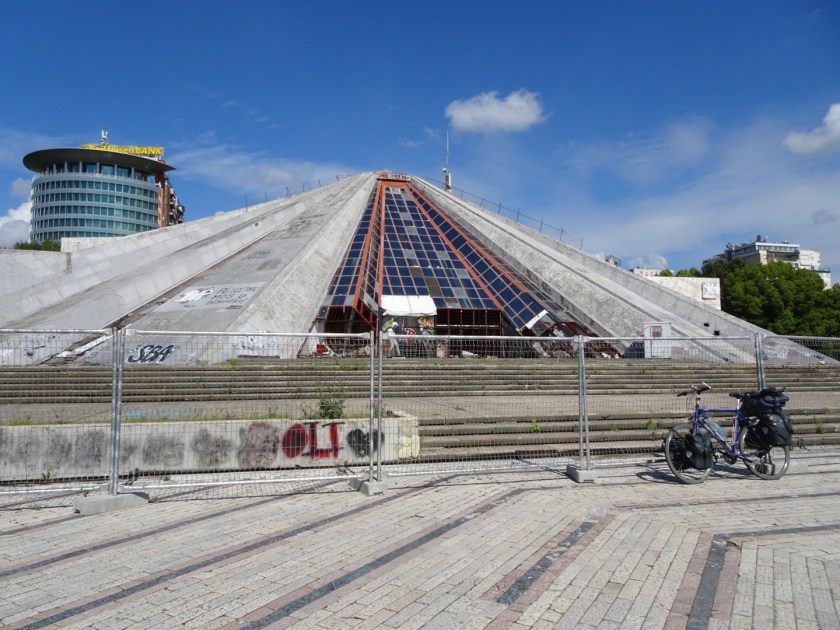
We return to Tirana in the early afternoon so have plenty of time to discover more of the city. First it’s time for lunch though and we really want to try the local burek. We’ve had plenty of cheese and spinach versions but today we get a meat slice.. it’s fantastic and I’m happy in my belly! We check out the abandoned “Pyramid of Tirana” which was originally built as a museum to Enver Hoxha but now sits derelict as a reminder of that time.

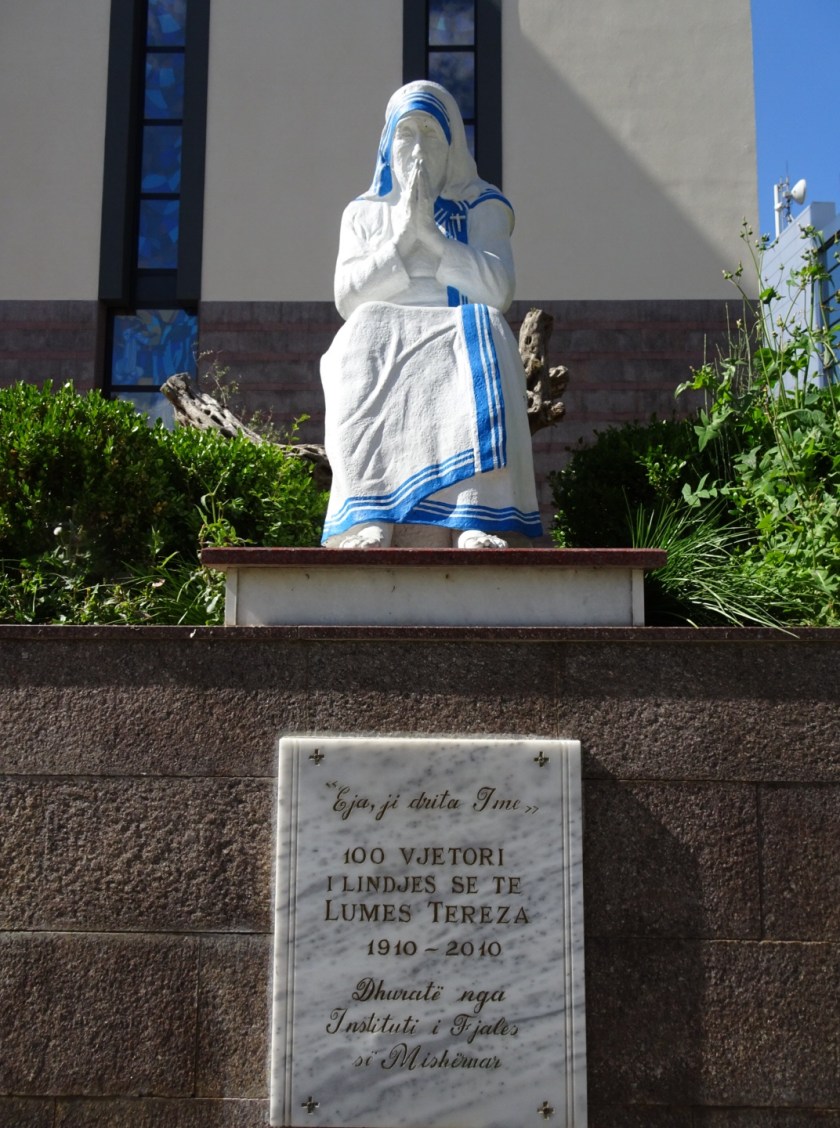
We continue to find statues of Momma T., this one outside the main catholic cathedral.

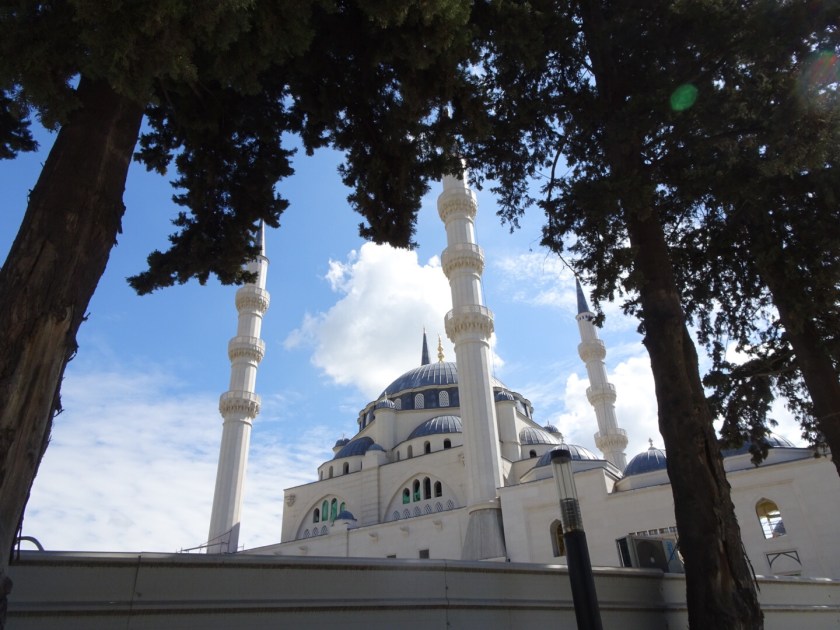
In very close proximity you can see Orthodox and Catholic Churches side by side with mosques… the Albanian people pride themselves on living in religious harmony. Apparently in the last census, well over 50% of the population identified as Muslims but of those 90% had never been to a mosque. They don’t take religion too serious in this country.

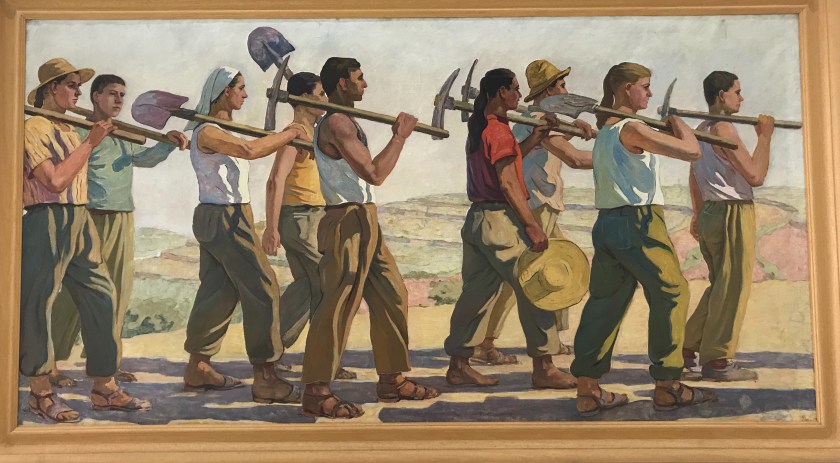
We visit the National art gallery and see some very peculiar modern art but then some really interesting paintings from the communist era

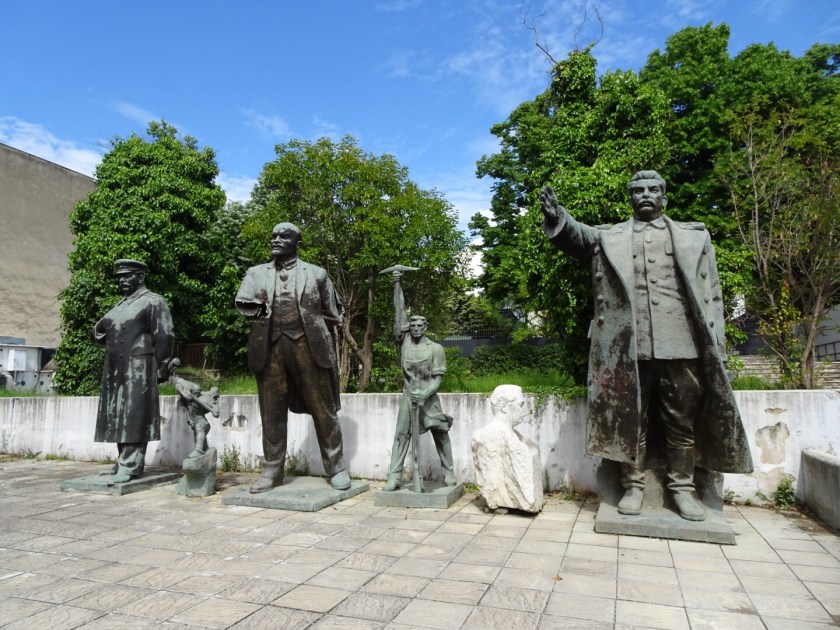
Around the back outside the building there are statues of Lenin, Stalin and Hoxha

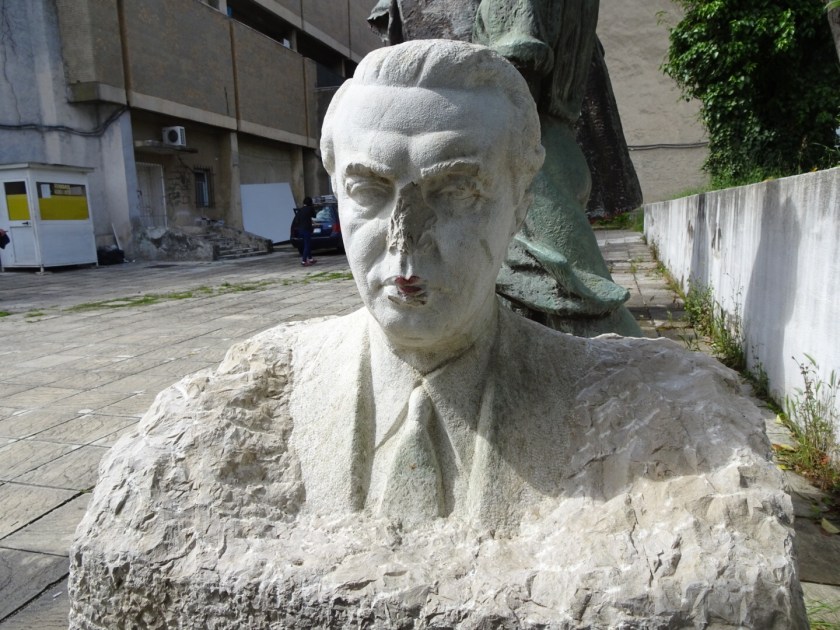
I needed a visual on this Hoxha guy:

Our last museum to visit is called The House of Leaves or the Surveillance Museum and it’s another dark tale of how the regime bugged residents homes, spied on visitors and nationals and interrogated and tortured those who were anti-communist. Gonna need a beer after this place…

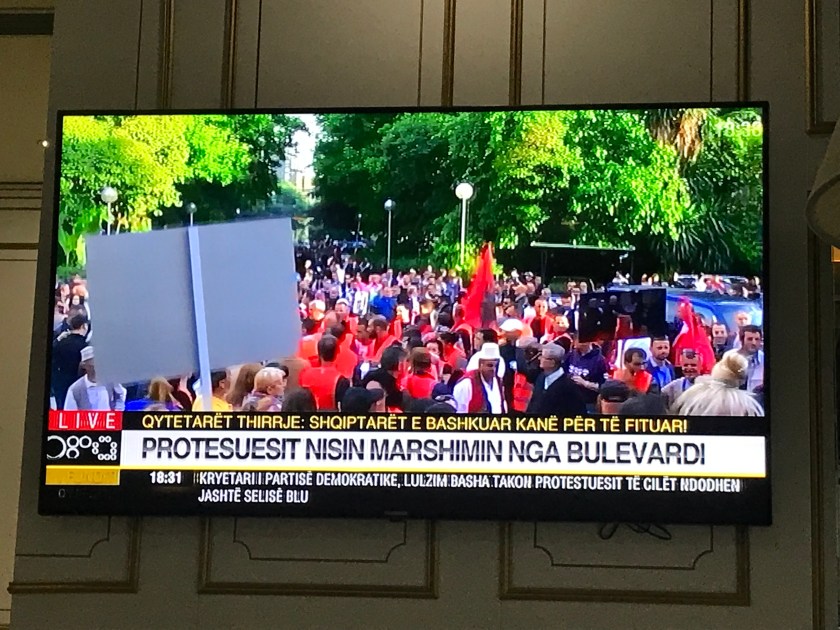
Tonight we are supposed to have a team dinner but the restaurant is close to the prime minister home and there is a big protest happening this evening so it’s been cancelled. Our guide tells us we are not allowed to go near the area as it could turn nasty.. sounds a bit ominous so of course we comply and make sure we are nowhere near by going for a few beers and some food near out hotel. It’s all kicking off just a few streets away though and we can hear some shouting. Although it didn’t get too out of hand apparently tear gas was fired!! We watched a bit of coverage on the news but couldn’t understand anything they were saying!

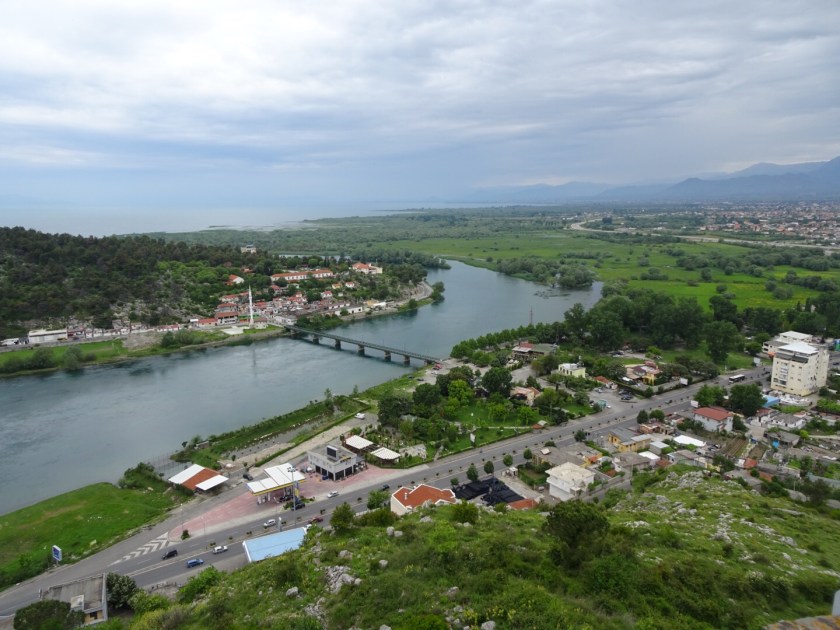
The last town in Albania that we get to visit is an ancient city called Shkoder, on our way out of the country the next morning. Shkoder is one of the oldest cities in Europe and now the main commercial centre and largest town of northern Albania. We check out the fortress which again overlooks the town (just like the many fortresses we’ve seen)…

It’s raining when we arrive into the town centre so we don our raincoats and venture through the wet streets. We visit a the Marubi National Museum of Photography which tells the history of a local man Pietro Marubi and the legacy of his photo studio. The photos are amazing….

We have a group lunch in a very fancy building which apparently was the family home of mother Teresa‘s mother and sister for years until they were kicked out when communism arrived. Mt. T came from a very wealthy family. After lunch we are back on the bus and driving to our next country – Montenegro.

Western Balkans Part III : Kosovo 🇽🇰

We take a day trip from Macedonia to the historical town of Prizren, in Kosovo which is Europe’s newest country declaring its independence in 2008. It’s a three hour journey by bus to the second biggest city, in this tiny country. The border crossing is easy but this time we’re hoping NOT to get a passport stamp as that would create problems if traveling to Serbia in the future. The Serbians still see Kosovo as officially part of Serbia so they would see entry to Kosovo as an illegal entry into their country and might not let us in! Anyway we’re not really worried about that now and we arrive at the small, pretty town of Prizren, where we can spend euros!

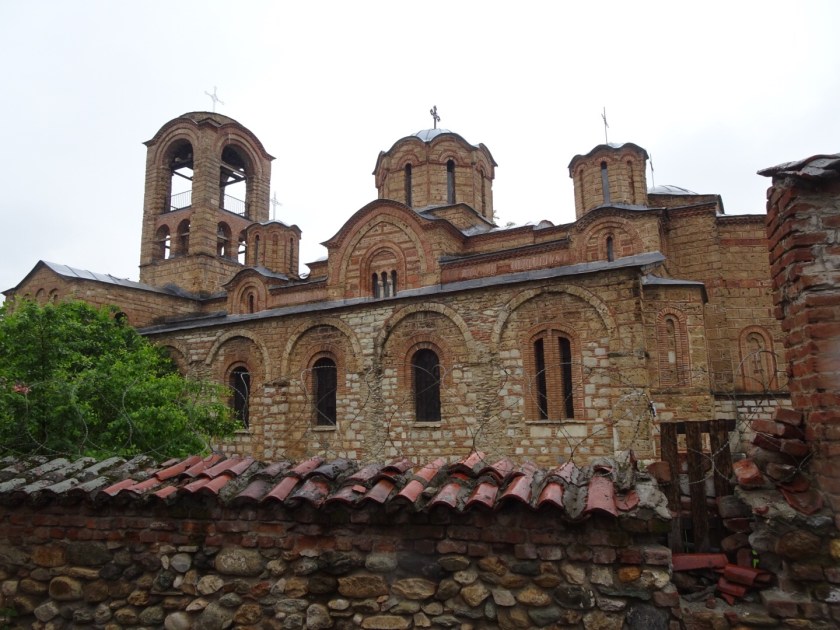
Of course there’s always a monastery or church of some sort to visit so we check this one out which is a UNESCO listed building.

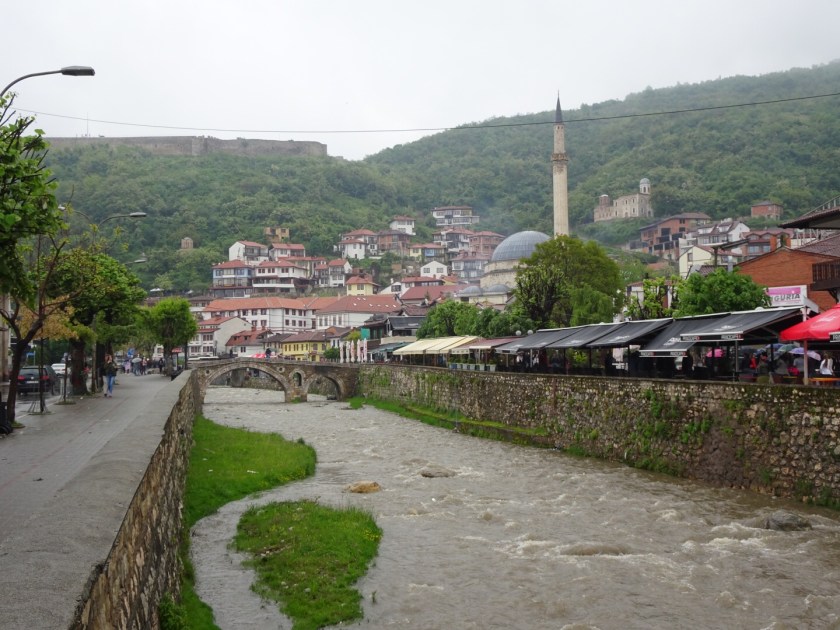
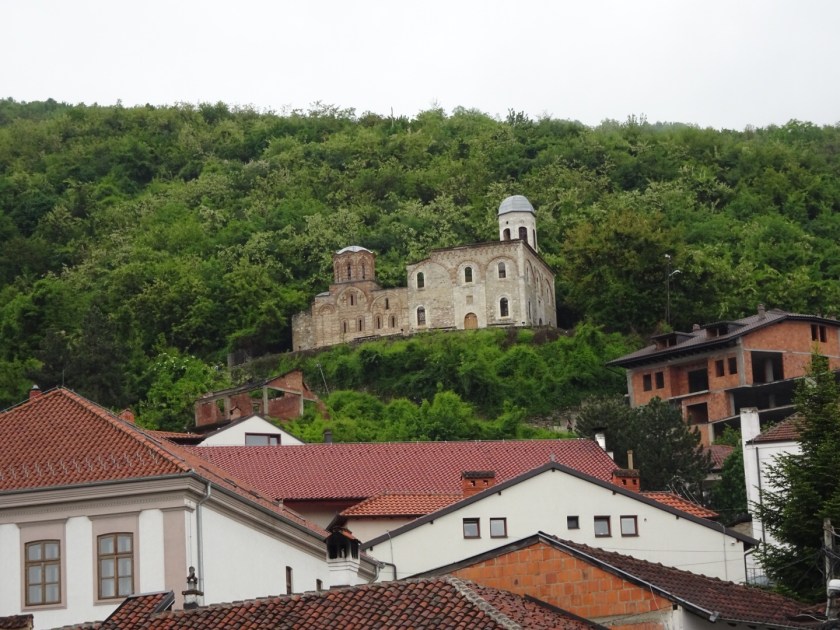
The most fascinating thing for me is this bombed out church that sits on the hill overlooking the town. It looks almost perfect looking at it from below but as we climb upwards we can see that it is just a shell and the whole inside has been destroyed. It was a Serbian Orthodox Church and in the late 90’s to 2004 many Serbian cultural sites were destroyed.

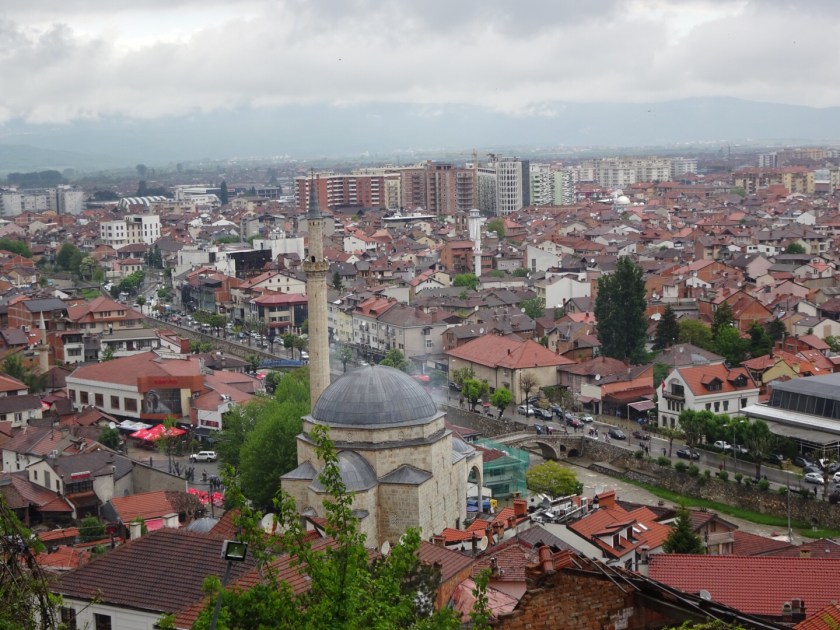
The views back over the town are pretty good from up here…

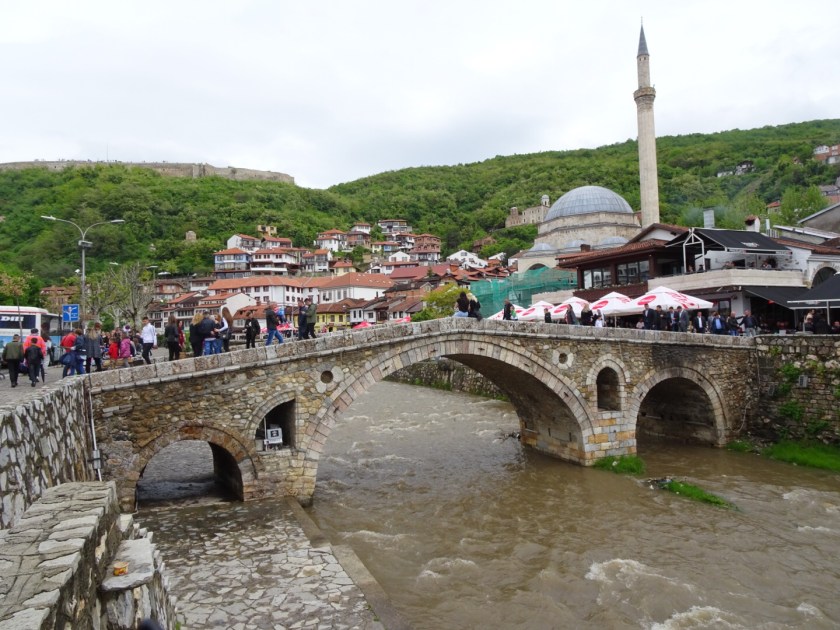
In between a few rain showers we visit the mosque, walk through the old streets and cross the old stone bridge.

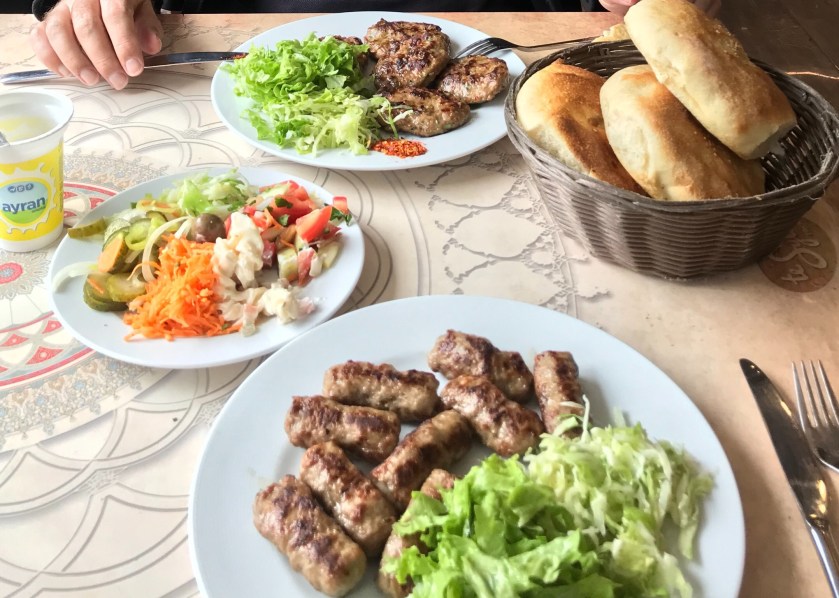
Time for some lunch and we have grilled meat similar to that in Macedonia and just as tasty.

We also find a craft brewery for a quick one to warm us up during a shower!

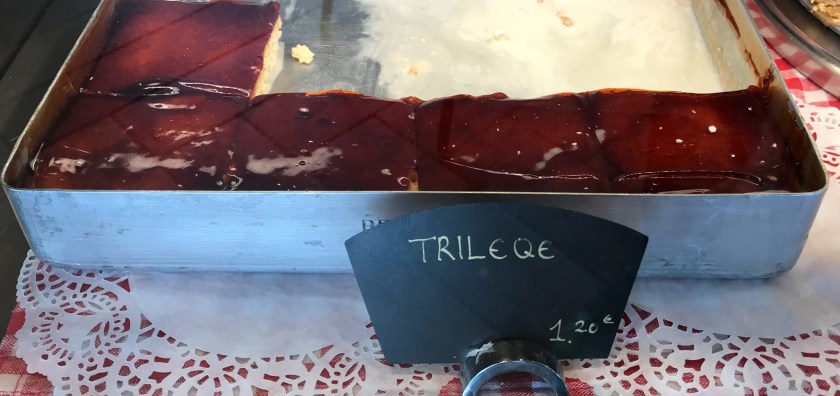
Before we leave, we go to a cafe where our guide has told us there’s a delicious dessert that we must try. It’s called “Trileqe” or tri leche i.e. 3 milks…. it’s surprisingly tasty, kind of custardy with a sweet glaze on the top. Not a bad way to finish our brief encounter with Kosovo.

Western Balkans Part II : Macedonia 🇲🇰

We take a bus from Sofia for the five hour journey to Skopje, the capital of Macedonia, or to be more accurate The Republic of North Macedonia. The name change was just recently agreed with Greece who also have a region called Macedonia.

The bus is a comfy coach and not full so we’ve lots of space. About two hours into the journey we reach the border. A border police official comes onto the bus and takes our passports from us individually. He goes off with them, presumably to stamp them and delivers them back about ten minutes later… then we realize that was the Bulgarian border control so now we have the same process a few feet up the road at the Macedonian border control! Another ten minutes there and we’re good to go. No passport stamp for me mind you.

We reach Skopje around 12 noon and drop our bags to the hotel so we can do some exploring before our welcome meeting later this evening. We’re on an Intrepid tour and we’ll get to meet our fellow travelers later today. We start by visiting the memorial home of Mother Teresa. She was born here in Skopje and although her house is no longer standing there’s a plaque, close to the main square, marking where it once stood. A short walk from the square is the memorial building which houses lots information, photos and artifacts from Mother Teresa’s life. I find out that she was born on the same day as me (August 26th) and there’s a photo of Loretto college in Dublin where she attended.

Happy to have ticked off the main thing I wanted to see in Skopje, we go for our first Macedonian lunch. We choose traditional chevapi (not how it’s actually written as they use the Cyrillic alphabet) and it’s really tasty…. throw in some salad, the giant bread and a local beer and we’re happy out!

Time to explore the rest of the city. Everything is centered around the main square Plostad Makedonija with a giant statue of “man on horse” in the middle:

In fact there are giant statues everywhere and you can’t go too far without seeing one or a set of two or three! Apparently there was a major renovation of the city (called Skopje 2014) with a view to creating a unique revitalized city. Many old communist buildings were given a facelift with newclassical facades and Greek style statues placed on them and massive statues of former glorious leaders were placed throughout the city. It certainly does give the city a unique feel.

More massive statues by the river with the picturesque Stone Bridge and a huge Greek classic style building behind.

The other thing I notice as we walk around is there are small plaques with quotes from mother Teresa (or Momma T as we now call her) in random places all over the city:

The pope is visiting in a couple of days so there’s lots of preparations going on around the town including barriers going up and streets getting closed off. We’ll be leaving just as he arrives.

We wander across the river and walk around the old town where there are lots of bars and cafes. Weirdly there are a huge amount of shops for very fancy evening wear…. over the top dresses are everywhere I look – I’d love to know where people are going dressed in these!!

After an afternoon of exploring we head back to the hotel for our welcome meeting and meet our tour group for the next 12 days. It’s a mixture of Americans and Australians and we’re a group of thirteen in total, including our guide Bashkim who seems cool. Here’s hoping we’re in for a good time.

Next day we take a thirty minute drive outside of Skopje to Matka Canyon, a deep ravine cut into the Suva mountains.

We hike along the edge of the lake, through the gorge

We take a boat ride and get some great views all along the canyon

We stop at Vrelo cavern, a water-filled cave with incredible stalagmites and unchartered depths – it’s speculated to be the deepest underwater cave in the world.

We head back into the city for lunch with the group and we have another delicious traditional meal with a glass of local red wine…. some pour for €1.10!

We spend the day walking around around the town again and visit the fortress where we walk the ramparts and get some great views of the city.

A quick stop at the Museum of the City of Skopje, housed in the old Railway Station. The buildings’ part-ruined exterior is a result of the 1963 earthquake. The large clock on the outside of the building is frozen at 5:17, the moment the earthquake shook the city.

Next morning we board our private bus to Lake Ohrid. This is Europe’s oldest lake, and allegedly one of the oldest human settlements in the world. The town is said to have once been home to 365 churches, one for each day of the year, earning it the nickname “the Macedonian Jerusalem”. After checking into the hotel and having a spot of lunch we set out to explore the small town. The view from the hotel:

We start with a short hike up to the beautiful tiny Orthodox Church (Sveti Jovana Kaneo) perched on the edge of the lake:

A medieval church next – St Clement and Panteleimon which is surround by ancient ruins and inside has amazing old mosaics and frescoes

We continue to the fortress sitting above the city:

The nations of the Balkans love their flags and you’ll always find one flying close by…

Continuing on the tourist trail we visit the ruins of the old Roman amphitheater but we stumble upon a really cool church with the most vibrant coloured frescoes we’ve seen. As we approach the church there appears to be no one around and then out of nowhere a man runs towards us and opens the door, turning on lights and ushering us in, we weren’t able to take photos but the frescoes truly were amazing and the guy talked us through many of them… it was quite a find, the church was called Mother of God Peribleptos.

It’s been a long day so we find a local “eatery” (as the guide calls them) and have some local food and wine before calling it a night.

Next dat we embark on a scenic cruise on the turquoise waters of Lake Ohrid, which is surrounded by mountains, villages and beaches. It is 34 kilometres long, 14 kilometres wide, and over 300 meters deep and is shared between Albania and Macedonia, although right now we are staying on the Macedonia side.

It’s sunny and the water is calm but the weather has been hit and miss and it’s a bit cool. It’s a beautiful two hour jaunt on the water though…

In the afternoon we take a short bus drive to St Neum, a monastery complex on the south side of lake Orhid near the Albanian border.

We explore the area, have some lunch and enjoy some glorious sunshine

Tonight we have our final meal in this wonderful country and after probably a little too much local red wine (so delicious and so cheap compared to home) we say goodbye and get ready to head west to Albania.

Western Balkans Part I : Bulgaria 🇧🇬

I’m off on my travels again, this time visiting some countries in the Balkans, mostly former Yugoslavian countries. Seven new countries in total which is exciting and I’ll get a little taste of each…

We start in Sofia, the capital of Bulgaria. It’s an easy three and a half hour flight direct from Dublin on Ryanair and twenty minutes on the train into the city. We’ve booked an Airbnb and it’s a really nice ground floor of a house within walking distance to everything. Our host Angelina has excellent English and gives us lots of good information. Her family are winemakers and they’ve left some red and white in the house that we can buy for 8 lev (that’s just 4 euros) a bottle. We shall definitely be trying that. We pick up a few supplies from the local BILLA, get settled into our new abode and then head out to explore the city.

As we walk toward the centre of town, Mount Vitosha is visible in the distance and it’s a nice backdrop to the city.

We don’t intentionally head for any of the main sites, but while rambling around we pass Banya Bashi mosque:

On the other side of the street is Central Market Hall – we do love a good food market so I’m guessing we might be back here:

Further down the Main Street there’s a large intersection with a monument erected in 2000 representing St. Sofia:

Next we come across the “Party House” which was built in 1954 to house the Bulgarian communist party:

And just around the corner, at the Presidency building, we catch the changing of the guard:

Continuing our ramble, we come upon the “Russian church”. Considered by some to be the most striking building in Sofia, it is beautiful on the outside and small and dark on the inside.

A few minutes walk from here is the Aleksandur Nevski Memorial church. This is the key landmark in Sofia. It was built to commemorate the Russian prince Nevski and his success in the War of Liberation. It’s impressive on the outside but not so much on the inside.

En route to Vistosha street, where the main bars and restaurants are located, we pass the Opera house which is beautiful:

Angelina recommended a restaurant called “Shtastlivetca” which means happiness and we’re delighted to get a table as it’s very busy. We have a really good first meal of Bulgarian food and local wine from Melnik.

Day 2: Today we plan to cover all of what we’d like to see in Sofia so we can do some day trips before we leave Bulgaria. We set out for the National Palace of Culture which isn’t so much of a palace rather a large 70’s style concrete and glass block. It does have a beautiful backdrop of green hills and snowy topped mountains behind it but it’s not so easy to get a good shot… I tried….

We walk through one of the city parks on the edge of town. It’s sunny and there’s not a lot of people around so it’s really nice walking around. We have noticed that it’s common for people to drink alcohol in the park… not just drunks on park benches, it seems going to the park, or any common area and having a few cans is an acceptable social outing. Everywhere feels very safe though and although people aren’t overly friendly, everyone we encounter is pleasant.

There are so many pastry shops with all sorts of delicious savory pastries – they are unavoidable. Around lunchtime we try a couple that have meat and cheese and they don’t disappoint.

There are Roman ruins all over the city which is very cool. Although there’s plenty of graffiti on buildings, in alleys etc, none of the ancient remains seem to be vandalized in any way. I find this quite amazing as a lot of them are just on the side of the road and not protected in any way. We continue to The Monument of the Soviet Army built in the 50’s. A reminder of the communist days, it’s not very popular with the locals.

We visit the Church of Sveta (saint) Sofia next. This is the oldest surviving church in the city and has a museum underground with the remains of over fifty tombs and mosaics, some in very good condition, dating back to Byzantine and Roman times.

There are so many churches in Sofia. The Orthodox churches differ from the Catholic churches in a few ways – firstly you stand for any services so they tend to seem big and empty, secondly they have few windows and tend to be dark giving an air of mystic and thirdly the alter is hidden behind a huge screen covered in icons, called the iconostasis and only the priest is allowed to go behind it. Generally you’re not allowed to take photos but when we call into the next church on our list – Sveta Nadelya there’s a wedding so I take a sneaky snap!

On our way home we stop to fill our water bottles at the mineral baths. There are lots of people filling bottles as this is mineral water to drink. Strangely enough it was hot water though….. not for me!

Tonight we dine at a restaurant called Moma, where we’ve made a reservation ahead of time. It’s in a really cool building and again we have traditional Bulgarian wine and dishes. I have rooster cooked in a clay pot which is delicious. Another successful day in Sofia and might I add, over 20,000 steps walked. 😀

Day 3: Today we take a bus tour to the Rila monastery. On the way, about twenty minutes outside of Sofia is Boyana church. Inside the tiny church that allows only ten people for ten minutes at a time are some amazing 13th century frescoes (no photos allowed).

The main attraction is a further hour and a half away and it’s well worth the journey. Nestled among beautiful mountains and feeling very remote is the Rila Monastery:

The monastery was founded in the 10th century by St. Ivan of Rila. The guide talks us through the history of the monastery and the story behind some of the intricate murals covering the walls and ceilings of the church. A lot of them depict sinners going to hell while others are scenes from the Bible.

Inside the main church there is a large iconostasis and elaborate light fixture

Also inside the church is the grave of Tsar Boris III. He was the leader during WWII and although aligned with Hitler, he refused to deliver the Jewish population to the same fate. Jews were forced into labor camps but apparently none were killed and their population remained the same pre and post the war.

After some free time to explore, it’s back on the bus for the two hour journey home.

Back in Sofia we visit one last church that we missed yesterday. It’s the Rotunda of St. Georgi and it’s oddly placed in a courtyard between a large hotel and the Presidency building.

Another fantastic meal tonight at a restaurant that is just around the corner from the house. It’s one that was recommended by our host and also rates high on TripAdivser so it’s a little touristy but the food is amazing and we get a little bit of local music. We order Bulgarian salad, lamb delicacy (which includes lambs brains and tongue) and pork in a clay pot. More local red wine and some rakia (not for me, I can’t handle the local fire water) ensures a great night all round.

Day 4: Another bus journey today, this time to the second biggest city in Bulgaria – Plovdiv. We board the local bus and after some confusion with the assigned seating we are on our way – in separate seats! It’s a two hour drive and having left at 9am we have most of the day to explore this ancient city full of Roman ruins, National Revival mansions and historical charm.

One of the main sites is the Roman amphitheater where they’re setting up for a concert:

Today is the hottest day so far and we get out of the sun for a little break to visit the Icon museum. This is St. Cyril and Methodius – I think they look like twins – I must find out about them!

I’m pretty sure today will be a 20,000 steps day as we’ve pretty much covered the whole town, which is built on three hills and is essentially a maze of narrow cobbled streets! We’ve visited the Church of Konstantin and Elena:

And the impressive Kuyumdzhiogh house, currently the Ethnographic museum:

At this stage my feet are sore and I think we need a little rest. Shane has found that Plovdiv has some craft beer bars so we’ll check that out before heading back to Sofia.

For our final meal we spotted a very popular grilled meat establishment so we load up on that along with some interesting salads and have a quiet evening before setting off for country number two tomorrow.

Burma Part VII : More Yangon, Golden Rock and Bago

We are back in Yangon and en route to the hotel we get the chance to stop at the home of the president, Aung San Suu Ky. This is the house where she spent her time under house arrest (approximately twenty years). You can’t actually see the house as it’s guarded and surrounded by large gates.

We have a free afternoon in Yangon so we decide to take a train to experience how the locals live. Apparently it’s the thing to do!! It costs 200ks (pronounced jets) which is 10 cents!! It’s a three hour journey on a circular train so we decide to do half of the journey and then take a taxi back to the city. But first we need lunch so we go to a famous restaurant called Monsoon. It looks like we won’t make the train on time so in our wisdom we decide we’ll taxi to the half way point which is a a market at a stop called Danyingon and take the train back. Delighted with our plan, Suzanne and I along with our Austrian friends head off in a taxi ……. cut to an hour and a half later sitting in a taxi, sweating with the heat and crazy traffic we are realizing this wasn’t a great idea… it’s tough to communicate with the taxi driver and he keeps saying what sounds like Buddha and I’m worried he’s bringing us to a Buddha statue not a train station. We are all laughing but it’s starting to feel a bit uncomfortable! Well eventually we get there and it’s a relief to get out of the car…

The bad news is that the next train is not for nearly an hour and the market is very “local”… in reality manky… we barely walk through one row and have had enough. Smelly fish alongside fruits and veg, in the heat with a load of flies.. it’s not pleasant. We hang around waiting for the train and it is interesting to watch the people, in particular those who have set up shop on the railway tracks. This is platform 3 (no joke) where our train will arrive:

When the train finally arrives the people eventually move but they leave all their goods and the train drives over them but they’re perfectly in tact underneath …. it’s quite incredible. As there’s no platform it’s a huge step up onto the train. I try to go first but can’t get up too easy so Martina who’s tall jumps up ahead (with a bit of a hoosh) and helps the rest of us up. It’s comical as we’re doing this at high speed in case the train pulls off. It’s quite empty and a reasonably pleasant ride with the doors and windows wide open

No joke this woman jumped from the train as it slowed down but before it stopped. It was an impressive move while balancing all that on her head!

Unfortunately we have to change at a station in order to get to Yangon and we’re told there’s no train til 8pm… it’s not even 6pm right now… yikes!! Guess we have to get back in a taxi – what a bad choice of things to do for an afternoon, we essentially spent the whole time in traffic. Ah well, it was somewhat of an interesting experience and we can get the taxi to drop us at Sakura Tower for a drink at the sky bar which has some great views of the city.

Next morning we are picked up by a guide and driver and we are driving south to the Golden rock. First I try mohinga for breakfast – it’s catfish soup with noodles and very tasty:

It’s a four to five hour drive depending on traffic. The guide Oma, is fantastic and tells us lots of things about the country including taking us through a map and showing each of the states and divisions and where different tribes live and what different resources are where.. it’s super interesting and informative. We see some nice scenery on the way and not far from golden rock there is a giant Buddha being built. From a distance it looked like part of the mountains. It should be finished by 2020.

The golden rock is situated up a mountain and in order to get there we have to leave our car and get into a truck. The trucks are the only transport allowed up. They have six rows with six people in each row and room for a few more in the front cabin or standing in the back with the bags. Every one of them is packed.

It’s a bit of a roller coaster journey up the mountain and the truck tears around the corners. We arrive to the top and there is a full-on little town up here. It’s busy with pilgrims and if you can’t manage the journey you can take one of these deck chair /stretcher thingys!!

We check into the Mountain Top hotel which is gorgeous and we have a great view out over the mountains.

After a little rest it’s time to see the rock. We’ve been told that unfortunately the rock is being cleaned – it only happens every five years so we are a bit unlucky but I’m hopeful we can still get a good view through the bamboo scaffolding. When we arrive to the first viewing point my heart sinks… it’s completely covered 😪😪😪

We continue up to the platform and experience the pilgrims praying and eating. There are a lot of people around and many will sleep out on the platform tonight.

There’s a whole other town up here.

Lots and lots of food stalls….

From another viewpoint we get a little better look where it’s not so covered up.. can you tell I’m sad behind that half smile…

We buy some gold leaf and a lovely guy offers to place it onto the rock for us as women are not allowed to touch it.

It’s a bit of an anti-climax after traveling all the way to see it but what can you do. We soak up the atmosphere and then head back to the hotel for drinks and a really good meal.

We have a great view of the sun rising next morning and then it’s time to take the crazy truck back down. It’s harder going down as you keep falling forward. I found it hard to stay on the seat and my wrists were sore from trying to hold my body back. We pull in a couple of times to let trucks go past us and as it’s the weekend it’s very busy with pilgrims and lots of monks…

Reunited with our driver, we get back on the road to Bago. On the way we stop at a pomelo farm and taste some fresh pomelo just picked from the trees. It’s delicious.

We have a few stops in Bago (which was a former Myanmar capital) which I’m excited about – first The Shwemawdaw pagoda, a huge golden temple that can be seen for 10km around the city. As we approach we’re told that it’s closed as they are getting ready for a huge festival with 2,700 monks in attendance. Not to be deterred by that our guide gets the driver to drive around to a back entrance and blags her way in so that we can get a quick walk around the huge stupa…

Places are laid out for the monks:

Next a huge (55 metre) reclining Buddha built in the tenth century

Some monks having a lecture by the reclining Buddha:

A quick stop at another, even bigger reclining Buddha, more recently built but based on an ancient one that once stood here:

I love this statue of the Buddha being followed by his apostles:

The four seated Buddha’s at Kyaikpun is our nest stop and it doesn’t disappoint. Four gigantic statues back to back….

It’s quiet here with no tourists and we get accosted by a group of teenage boys who want a photo. What’s even funnier is that a group of girls come around the corner and when they see this they literally make a run at us and grab us sending the boys away so they can get a photo too.. such a giggle…

We also say hello to these young novice monks

We visit the Palace of Kambozathadi which has been rebuilt to show how it looked in its splendor. They excavated some of the original teak pillars that held it up which was very cool to see…. they’re huge!

There’s a lot of traffic as we arrive in Yangon but we make time to stop at a monastery where we see lots of novice monks praying:

And we get to meet this master as our guide knows him well. It’s an odd experience as we are ushered into a room where he’s sitting on a huge armchair (throne like) with about five monks sitting on the floor around him and a hospital bed in the room beside him (with beautiful pink floral sheets), apparently he hasn’t been well. One of the monks lifts a bowl to him to spit into after he coughs and then makes sure he has a towel to wipe his mouth. 😲 He does have a lovely relaxed and calm aura about him and he talks to us through our guide as he doesn’t have English. He says he’s been to Ireland and he’s also been to California a few times. By way of a blessing he places a yellow band around our wrists, being careful not to touch us as monks don’t touch women. It’s very pleasant if not a little peculiar but it does feel like an honor to have met him.

We eat at our hotel tonight and debrief on the day (in particular the monk visit) and have a lovely night view of the shwedagon pagoda form the restaurant:

Next day it’s time to leave Burma but we have a few hours with our driver and we’re going to make the most of it and see as much as we can. We start with a trip to the resting place of Aung San Suu Kyi’s mother which is next to the mausoleum of the last king and queen of Burma:

Next to those is U Thant’s mausoleum

Next it’s onward to the martyrs monument which is dedicated to General Aung San who is considered the father of democratic Burma. He was shot dead at the age of just 31 along with 6 cabinet ministers and is buried here.

There’s no English on the information provided but it’s interesting to see the photos and it’s a very atmospheric monument to walk around.

A short drive away is the house of U Thant (who’s mausoleum we saw earlier). He was the third UN Secretary General from 1966 to 1971. He was clearly a brilliant man who was famous for helping to resolve the Cuban Missile crises and many other international

Next a giant seated Buddha famous for having lifelike eyes (called Kobe Htat Gyi). He’s lovely but we don’t really see anything different about his eyes.

To finish off our site seeing we visit another Buddha, this time carved from a single giant piece of marble.

More requests for photos from the locals which we’d never refuse….

One final selfie and it’s off to the airport. Burma/Myanmar you have been wonderful and I really do intend to come back. But for now, ta ta!

Burma Part VI : Lake Inle

Day 9 : We set off from Pindaya after our amazing cave visit and start our 57km ride to Inle lake. The first half is tough going with lots of hills but the second half we’re downhill (arghhhh) or flat so it’s not too bad. We stop at a small family run business to see how they make umbrellas which is really impressive and hard to believe they still do this by hand. there’s got to be some machinery in the back!

We are staying in a town called Nyaungshwe and on arrival we stop for lunch before abandoning our bikes to an afternoon of leisure. We are all excited about staying at the Paradise hotel for three nights.

This evening we have all decided to go wine tasting at Red Mountain estate which just happens to be the wine we had last night. We try four different wines and then sit and watch sunset with another glass and a bite to eat.

Day 10 : It’s another 8am start and our final day of cycling. 50km to do… let’s get on with it…… my shoulders and bum are killing me!!! We start by cycling to a scripture monastery called Shweyanpyay and see young monks studying scripture or being distracted by foreigners and looking out the window!

Then we go “next door” to a really interesting temple filled with tiny Buddha statues in the walls all with the names of those who donated them.

There are some cool scenes created on the walls, the one below is a tree with women hanging from it and men trying to climb up and catch a girlfriend!!!!

We cycle all 50k in more or less one go and then say farewell to our bikes before doing some siteseeing. The support team and mechanic have been amazing and we say goodbye to two of them. I grab an opportunity for a photo with our amazing guide Naing.

Delighted to have complete over 450km since we started last week…

We visit Shwe Inthein which is a real treat and holds over a thousand slender Shan style stupas with spires.

It’s so impressive walking around and Ni takes us the back way out “Indiana Jones” style, in his words!

There’s a temple in the middle with these golden ones… hundreds of them…

There’s not much security and you can walk freely around and even jump into some of them!

On our way through the local village we meet this lady who happily stands around saying hello and getting her photo taken with the likes of us foreigners!! I’m curious to find out how old she is and Ni tells us she’s 74!!!! That’s what sun and cigars will do to you! [I hope I look as good as my own mother when I’m her age!]

We take a boat on the lake and head back home. The cool breeze is nice as it’s still in the high twenties (roasting for me)….

We see the local homes on the side of the lake

and fishermen fishing with a very distinct style and method

We get back to the hotel not long before sunset and I realize this is my chance for a massage. I book a 90 minute full body massage at a “spa” called Jasmine (recommended by the hotel) and they pick me up in a lovely car to take me for my appointment. The premises are very basic, as expected, in fact I’m not even in a proper room – I’m in the hallway with a sheer, but dark colored cloth around the massage table!! That said, the massage was magnificent. The first part was a lengthy foot massage that included everywhere up to my knees and the second part, the young girl stretched and twisted me til I thought she might break me!!! Her knuckles in my neck totally sorted out the pain I had there and I got the best sleep of the whole trip afterward! Fabulous 😀

Day 11: A change of pace today on Inle lake. We travel by boat and visit the local cottage industries. We start off with a temple though, because it’s hard not to visit a temple around here! The main centerpiece of this one is these five Buddha statues that have been adorned with so much gold leaf that they are now unrecognizable as Buddha statues… quite bizarre! There’s a story of how they were lost in the lake when they were being transported to the temple many years ago, also a bit bizarre but with a happy ending as here they are!

We see more fishermen on the lake but these ones are posing and although once catches a fish they’re really just there for photo opps!

We see women taking thread from the lotus plant which will ultimately be used to weave beautiful patterns onto silk and make lotus scarves, cushions etc..

We see blacksmiths bashing metal..

And we see women making cigars… I took this photo but I didn’t sit through the demo or “tasting”- yuuuuuuck!!!

Lastly we see the boats being made out of teak wood.. that was really interesting to see:

Theres all sorts going on on this lake adventure and it’s nice to see it all as we float by..

On Arrival back to town we decide to end the day with a cocktail at a rooftop bar to watch the sun go down… two mojitos in quick succession put a lovely hazy lazy feel to the sunset!

Day 12 : We say goodbye to Inle lake today and head for Heho airport back to Yangon

Burma Part V : Pindaya

Day 8: We leave Mandalay and board yellow bus for a three hour ride, crossing the border into Shan state. The journey brings us higher and higher into the mountains on very windy roads but our guide tells us it’s very safe as where we are going is deemed one of the safe towns by the military government.. what!!!! I’m having flashbacks of that movie Babel (you know the one with Brad Pitt where they’re in Morocco on these remote roads and his wife gets hit by a stray bullet out of nowhere)… yikes!!! The scenery is lovely though…

After lunch our bikes are waiting and we cycle fifty miles to a town called Pindaya.

It’s a really tough day cycling with many hills and some terrifying downhill. We stop to get a quick photo of this cool spot called Brave Womans Mountain:

At the end of our bike ride we arrive at our very cool accommodation for the night – The Conquerer Resort hotel.

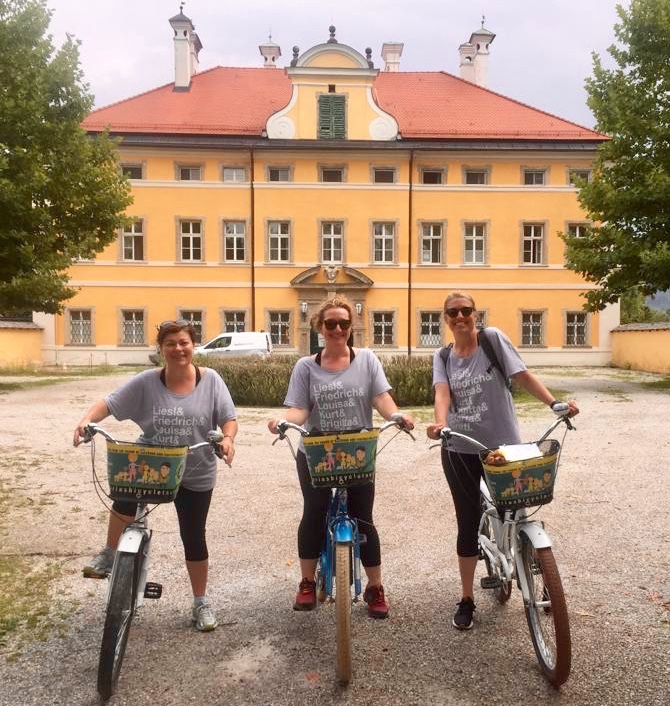
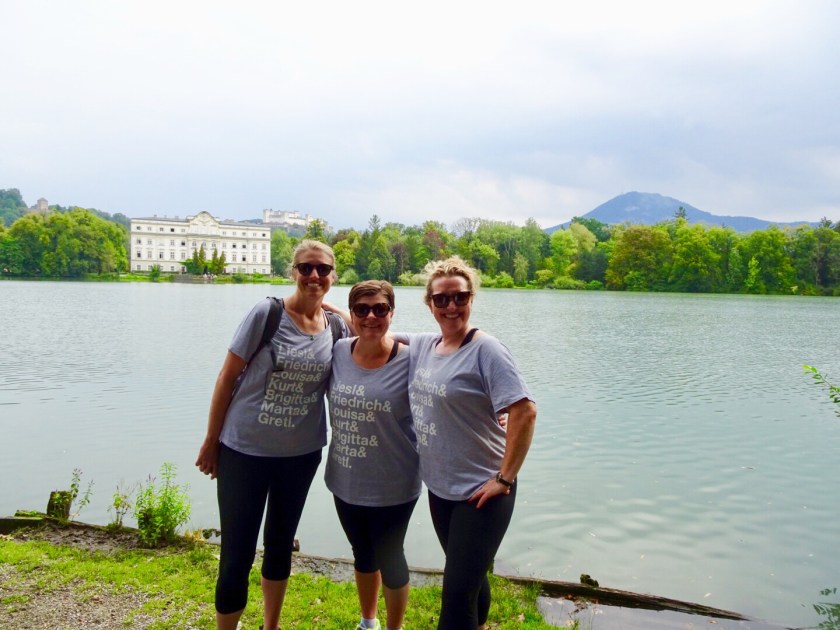
After a quick shower it’s time to head out for dinner and we go to a really nice restaurant called “Green Tea”. It’s gorgeous and, per the guide (and lonely planet) the best in the town, but we are the only people there! The good news on arrival is that they have wine… we haven’t really been anywhere that has wine so we check it out and settle on a bottle of Myanmar rosé from Inle lake. It’s actually really nice and goes with our peanut curry, mine with butter fish and Suzanne’s with butternut squash. We have great fun chatting with our group over dinner and then we walk home chatting about all sorts. So apparently the majority of Austrians and Germans haven’t seen the Sound of Music – I’m totally horrified and insist everyone watch it immediately upon their return home! 😀

Day 9: We have an early wake up call (whats new!) to go to the Pindaya caves. Wow is this worth it though. Pindaya is named from the story of a prince who killed a giant spider to save seven sisters. You can’t miss the spider at the entrance!

I thought I’d seen the most Buddha’s in one place I was ever going to see at Shwedagon pagoda but here there are row upon row, shelf upon shelf reaching the length and breath of the cave. Apparently 8,004 in total and they just stopped accepting more in 2015.

Among the Buddha’s are some stalagmites and stalactites but this cave is all about the statues.

We return to the resort, have some breakfast and it’s time to get back on the bikes. Today we are cycling 57km to Inle lake…..